What is cyanuric acid, stabilizer, or conditioner?
Cyanuric acid is pool stabilizer that protects chlorine from sunlight; labels also call it conditioner, and tests shorten it to CYA. For outdoor pools where you add chlorine yourself (tablets or liquid), 30 to 50 parts per million (ppm) is a common target.
CYA temporarily binds with some chlorine, holding it in reserve where sunlight breaks it down less readily. As unbound chlorine gets used up, bound chlorine is released to restore the balance. This helps chlorine last between additions, but CYA does not sanitize water itself.
The tradeoff is lower chlorine strength at the same test reading. More CYA leaves a smaller share of chlorine immediately active against contaminants. Your free chlorine reading includes both immediately active chlorine and chlorine temporarily bound to CYA, so the number needs to be read alongside stabilizer.
That is why a measurable chlorine reading does not always mean the pool has enough disinfecting activity. Adding conditioner to a pool that already has enough can make its existing chlorine routine inadequate. The phrase chlorine lock is misleading: chlorine still works, but its activity changes as CYA rises.
What CYA level and chlorine reading should you maintain?
For a residential pool where you add chlorine yourself, a widely used maintenance guideline is to keep minimum free chlorine at about 7.5% of the CYA reading. At 40 ppm CYA, that means about 3 ppm free chlorine. At 60 ppm CYA, it means about 4.5 ppm.
Those numbers are minimums, not ideal dosing targets. Maintain a margin above the minimum so chlorine does not fall below it between tests. This guideline is for routine maintenance, not treatment of an algae outbreak.
| CYA reading | What to do in a pool where you add chlorine yourself |
|---|---|
| Below 30 ppm | Confirm the result and your pool's target before adding stabilizer. |
| 30 to 50 ppm | Maintain this common working range. At 40 ppm CYA, keep free chlorine above the roughly 3 ppm minimum. |
| Above 50 but below 80 ppm | Stop further CYA additions and adjust chlorine to the reading. At 60 ppm CYA, the minimum is about 4.5 ppm. Consider water replacement if you cannot reliably maintain the higher chlorine level. |
| 80 ppm or higher | Confirm the result and plan partial water replacement to return toward 30 to 50 ppm. This is usually more practical than maintaining progressively higher chlorine levels. |
Saltwater pools have an equipment-specific exception. They still use chlorine, produced by a salt cell, but some manufacturers specify CYA around 60 to 80 ppm. A reading of 80 ppm therefore does not automatically call for dilution in a saltwater pool. Use the generator's specified CYA and chlorine ranges together; our technicians confirm those targets after checking the model.
A generic test strip's acceptable chlorine band cannot account for every CYA level. Record both readings before deciding whether chlorine is sufficient.
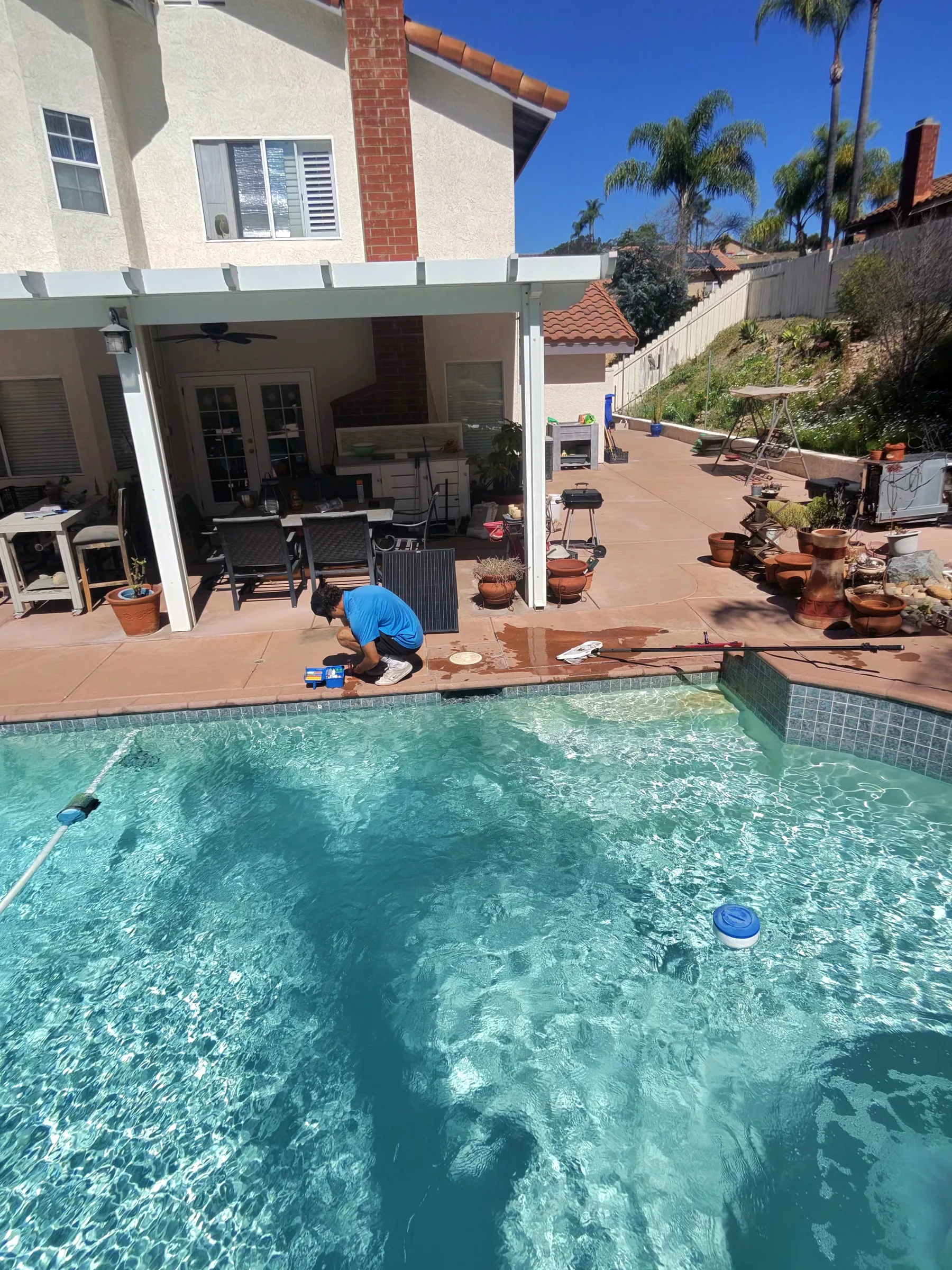
What adds CYA, and how do you stop it creeping up?
Separate stabilizer raises CYA, as do trichlor tablets and dichlor granules; liquid chlorine and chlorine made by a salt cell do not. If testing confirms a low reading, our guide to raising cyanuric acid in your pool explains how to add it.
For a rising reading, focus on your ongoing chlorine routine. Chlorine gets consumed while the stabilizer supplied with it generally remains. Continuing tablets after reaching your CYA target can therefore push the pool beyond its intended range.
Check CYA about monthly during regular operation and record the chlorine products used between tests. Most California pools run year-round, so continue those checks when swimming slows down. Cooler weather does not stop each stabilized tablet from adding CYA.
Once CYA reaches your chosen target, arrange a chlorine routine that does not keep adding stabilizer. Changing products also means establishing an appropriate dose and testing schedule; liquid chlorine will need replenishment as it gets used up. Check the active ingredient on products labeled shock before making repeated treatments.
Never mix chlorine products or put a different chemical into a feeder containing another product or its residue. Follow the chemical and feeder instructions when changing your routine. Switching chlorine sources prevents further accumulation; it does not remove existing CYA.
Why does chlorine keep dropping when CYA is in range?
A falling chlorine reading can reflect chlorine demand, the chlorine used up by sun, swimmers, and debris. Algae can also consume chlorine quickly. If CYA already matches your pool's target, adding more conditioner will not correct an inadequate chlorine supply.
Inland Southern California and Sacramento heat can increase chlorine use. Test chlorine more often during hot weather and heavy swimming, then adjust dosing or salt-cell output to keep up. Heat changes how much chlorine the pool needs, not automatically its CYA target.
Coastal marine-layer mornings still allow ultraviolet light through, so cloud cover cannot replace a stabilizer test. Neither a gray sky nor a hot forecast tells you how much CYA remains in the pool.
If water becomes cloudy or algae appears despite measurable chlorine, check CYA, free chlorine, pH, circulation, and filtration together. Compare chlorine with the minimum appropriate to the CYA reading before assuming the sanitizer is working adequately. Our guide to raising free chlorine in a pool explains the next steps when the chlorine supply needs attention.
How do you confirm and lower high cyanuric acid?
Confirm an unexpectedly high CYA result before planning water replacement. A result at the top of the test's scale may mean the concentration exceeds that number, rather than equals it. That distinction changes how much water needs replacing.
- Repeat the test correctly. Use a fresh sample after the pool has circulated. Follow the kit's sample volume, mixing time, lighting, and temperature instructions.
- Read the correct endpoint. With a disappearing-dot test, read the level where the dot disappears according to the kit instructions. The scale is not evenly spaced, so do not estimate it like a ruler.
- Resolve an off-scale reading. Use the kit manufacturer's dilution procedure, if provided, or have the sample checked with a method that measures the higher range. Do not invent a dilution ratio.
- Check recent additions. If stabilizer was just added, allow the product's specified circulation and retesting period before making another adjustment.
For confirmed excess CYA, partial water replacement is the usual correction; ordinary filtration does not remove dissolved stabilizer, and evaporation top-ups leave it behind. Rain can dilute CYA when pool water overflows or is removed and replaced, so retest after circulation at the normal water level before planning additional replacement.
The replacement amount depends on the confirmed starting reading, the desired target, and the replacement water. Do not empty the pool yourself. Our technicians assess the pool and site conditions before planning pool water replacement and restart service.
After replacement, circulate and retest CYA before adding conditioner. Also check free chlorine, pH, alkalinity, calcium hardness, and salt where applicable because replacement water changes more than stabilizer.
For your next service visit, have the dated CYA and chlorine readings, chemical labels, and salt-generator model ready. Note recent stabilizer additions or overflow. Our weekly pool cleaning and water chemistry service can use those details to set a chlorine routine that keeps CYA from climbing again.