Raise cyanuric acid with a measured stabilizer dose
To raise cyanuric acid in your pool by 10 ppm, add approximately 13 ounces by weight of 100% cyanuric acid per 10,000 gallons. For many outdoor pools using manually added chlorine, 30 to 50 ppm is a practical target, while saltwater pools should follow the chlorine generator manufacturer's specified range.
Cyanuric acid, also called CYA, stabilizer, or conditioner, protects chlorine from sunlight. Without enough protection, an outdoor pool can lose chlorine quickly during daylight. Adding stabilizer does not add sanitizer, so test free chlorine separately and maintain it while correcting CYA.
The common advice to add conditioner works when a reliable test confirms a shortfall. It fails when homeowners treat every chlorine drop as proof of low stabilizer. Inland heat, swimming, and debris can increase chlorine demand even when CYA is already adequate. We start with the measured CYA level before choosing a dose.
Confirm the reading before choosing your target
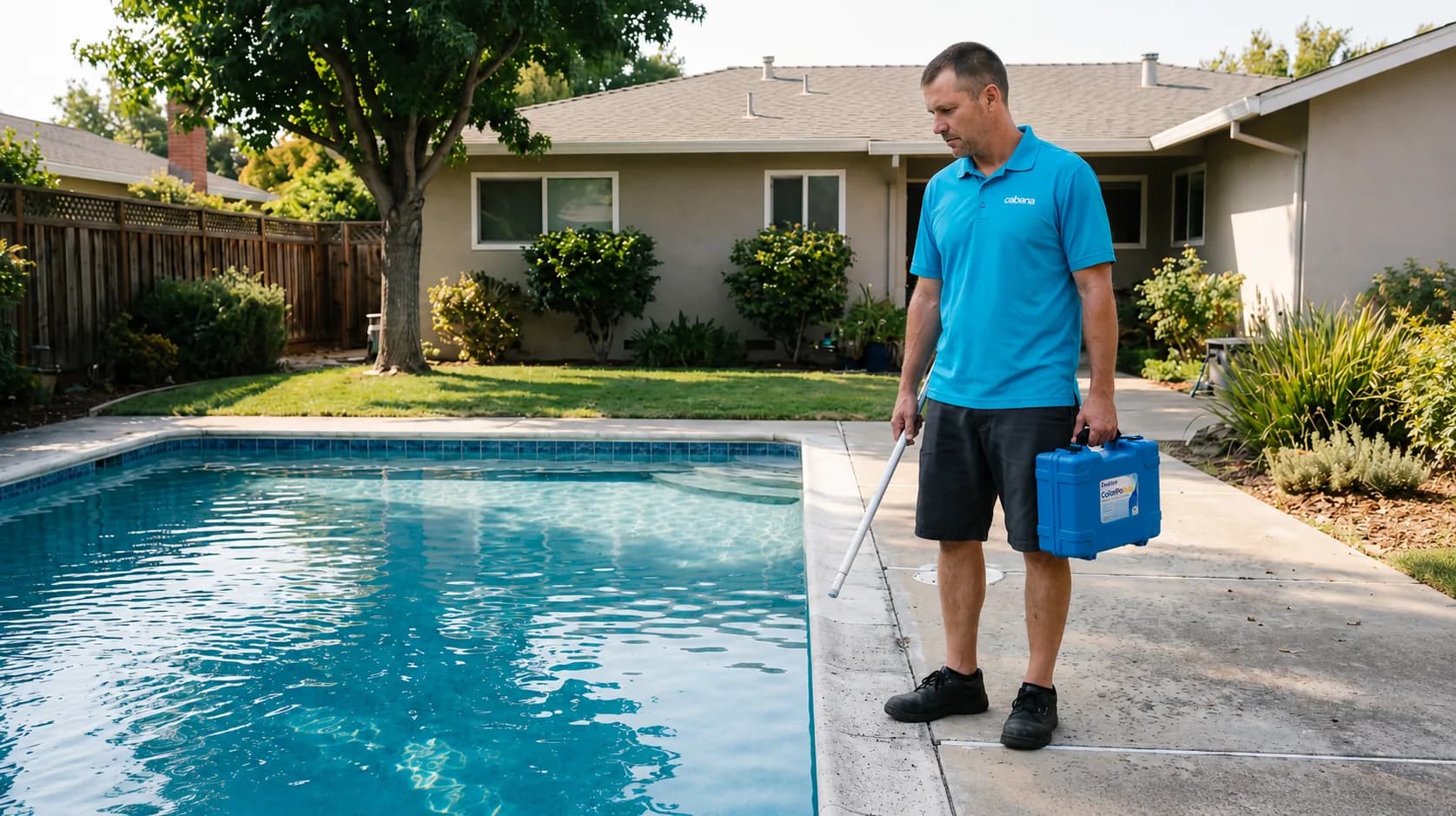
Test CYA with a pool test kit designed to measure it. Follow its lighting, sample temperature, and viewing instructions. With a cloudy-dot test, reading the tube indoors or under inconsistent light can change the result. If a strip gives an uncertain result, confirm it before adding chemicals.
Check the kit's lowest measurable value. A result below its scale does not necessarily mean zero. Treating an uncertain reading as zero can produce an oversized dose, especially in a smaller pool.
| Pool situation | Decision before adding CYA |
|---|---|
| Outdoor pool with manually added chlorine | Use 30 to 50 ppm as a practical starting range, coordinated with your chlorine routine. |
| Outdoor saltwater pool | Check the generator manual. Some systems specify a higher range. |
| CYA already at the selected target | Do not add stabilizer to address low chlorine. |
| Stabilizer added recently | Wait for the product's specified retesting interval before deciding on another dose. |
Coastal Southern California's marine layer does not eliminate ultraviolet exposure. Gray mornings alone are not a reason to skip stabilizer. Conversely, Sacramento's hot summers do not justify increasing CYA beyond the range appropriate for the chlorine system.
More stabilizer is not always better. As CYA rises, chlorine becomes less immediately active, and the required free chlorine level changes. Choose the CYA target and chlorine operating range together.
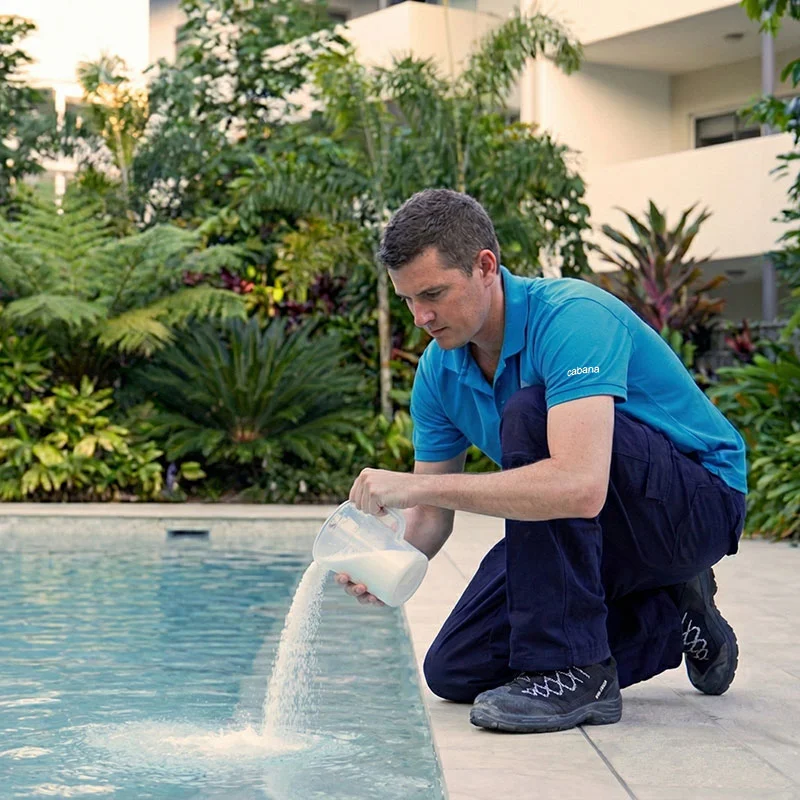
Calculate the dose from pool volume and the actual gap
Subtract the measured CYA from your chosen target. That difference is the increase you need. Calculate from the pool's water volume, including a connected spa only if it shares the treated water.
For example, a 15,000-gallon pool testing at 20 ppm needs a 20 ppm increase to reach 40 ppm. With 100% granular cyanuric acid, that requires approximately 40 ounces by weight, or 2.5 pounds.
| Pool volume | Approximate amount for a 10 ppm increase |
|---|---|
| 10,000 gallons | 13 ounces by weight |
| 15,000 gallons | 20 ounces by weight |
| 20,000 gallons | 27 ounces by weight |
These amounts apply to 100% cyanuric acid. Liquid conditioners and products with different concentrations require their own label calculations. Fluid ounces measure volume and are not interchangeable with ounces by weight.
When pool volume or the starting reading is uncertain, add less than the calculated full correction. Retest after the specified waiting period, then calculate any remaining shortfall. This gives you room to correct measurement error without overshooting.
Use the application method printed on your stabilizer
Advice to put stabilizer in a sock or pour it through the skimmer is not universal. Granular and liquid products can have different application instructions. The product label and equipment instructions determine which method fits your pool.
- Confirm circulation first. Make sure the pump is moving water normally before adding a product that requires circulation.
- Measure the planned dose. Use a suitable scale for granular stabilizer, rather than estimating with a household cup.
- Follow the labeled addition method. Use a sock method only when permitted, and keep concentrated material from resting against pool surfaces. Never mix stabilizer with chlorine or other chemicals.
- Allow the required circulation and dissolving time. Granular CYA can dissolve slowly. Visible disappearance does not necessarily mean the water is ready for an accurate retest.
- Wait before adding more. Follow the stated retesting interval, which can be several days for granular products.
If the label directs stabilizer through the skimmer, observe its restrictions on backwashing or filter cleaning. Removing water or cleaning the filter too soon can remove undissolved product. If filter service is already due, handle that before dosing.
Record the product, amount, and addition date. A low reading taken too early should not trigger another full dose.
Choose stabilized chlorine only when both levels need raising
Another common recommendation is to raise CYA with chlorine tablets or shock. This works only with chlorine products that contain stabilizer, and it changes two readings at once.
| Product or ingredient | Raises CYA? | Practical implication |
|---|---|---|
| Cyanuric acid conditioner | Yes | Raises stabilizer without supplying chlorine. |
| Trichlor or dichlor | Yes | Raises chlorine and adds stabilizer with continued use. |
| Liquid chlorine | No | Supplies chlorine without increasing CYA. |
| Calcium hypochlorite | No | Supplies chlorine and adds calcium. |
| Baking soda | No | Raises alkalinity, not stabilizer. |
Read the active ingredient instead of relying on the word 'shock.' Dichlor shock adds CYA; calcium hypochlorite shock does not. Salt chlorine generators also produce chlorine without adding stabilizer.
For Southern California pools with hard source water, calcium hypochlorite adds calcium to water that may already have plenty. That makes calcium hardness relevant when selecting chlorine, even though it does not change the CYA dose.
Most California pools operate throughout the year. Continued trichlor or dichlor use can keep adding CYA after the initial shortage is corrected. Once the target is reached, review the ongoing chlorine source instead of treating stabilized chlorine as a permanent solution to low CYA.
Check water loss before repeating the treatment
The advice to replace stabilizer whenever you top up the pool confuses evaporation with water replacement. CYA stays behind when water evaporates. Refilling to the original water level generally restores its previous concentration.
This distinction matters in hot inland valleys and during dry Santa Ana winds. Frequent evaporation top-ups do not automatically create a stabilizer shortage. In Southern California, those top-ups can also add more minerals, so test calcium hardness separately rather than assuming all balance readings move together.
Splash-out, backwashing, leaks, and overflow remove pool water containing CYA. Replacing that water with unstabilized water lowers the concentration. As a simple example, replacing one-quarter of well-mixed pool water lowers 40 ppm CYA to approximately 30 ppm, assuming no other additions or losses.
Use these checks before the next treatment:
- If only evaporation occurred, test before adding any conditioner.
- If pool water was removed and replaced, calculate the correction from a new CYA reading.
- If CYA is on target but chlorine falls quickly, check chlorine delivery, swimming load, and debris.
- If CYA repeatedly drops without clear water replacement, confirm the test and investigate the cause before continuing to dose.
Our weekly pool cleaning and water chemistry service can help coordinate stabilizer testing, chlorine adjustments, and equipment checks. Have your latest CYA reading, estimated pool volume, and chemical labels ready so our technicians can assess the next correction.