Raise free chlorine with a measured chlorine dose
To raise free chlorine in a pool, add pool chlorine according to the product label, your pool's gallons, and the increase your test shows you need. About 13 fluid ounces of 10% liquid pool chlorine raises free chlorine by 1 part per million (ppm) in 10,000 gallons, before the water consumes any.
Free chlorine is the chlorine available to sanitize the water. Use that reading to calculate your addition, rather than total chlorine, which also includes chlorine already combined with contaminants. Baking soda, pH increaser, and stabilizer do not directly raise free chlorine.
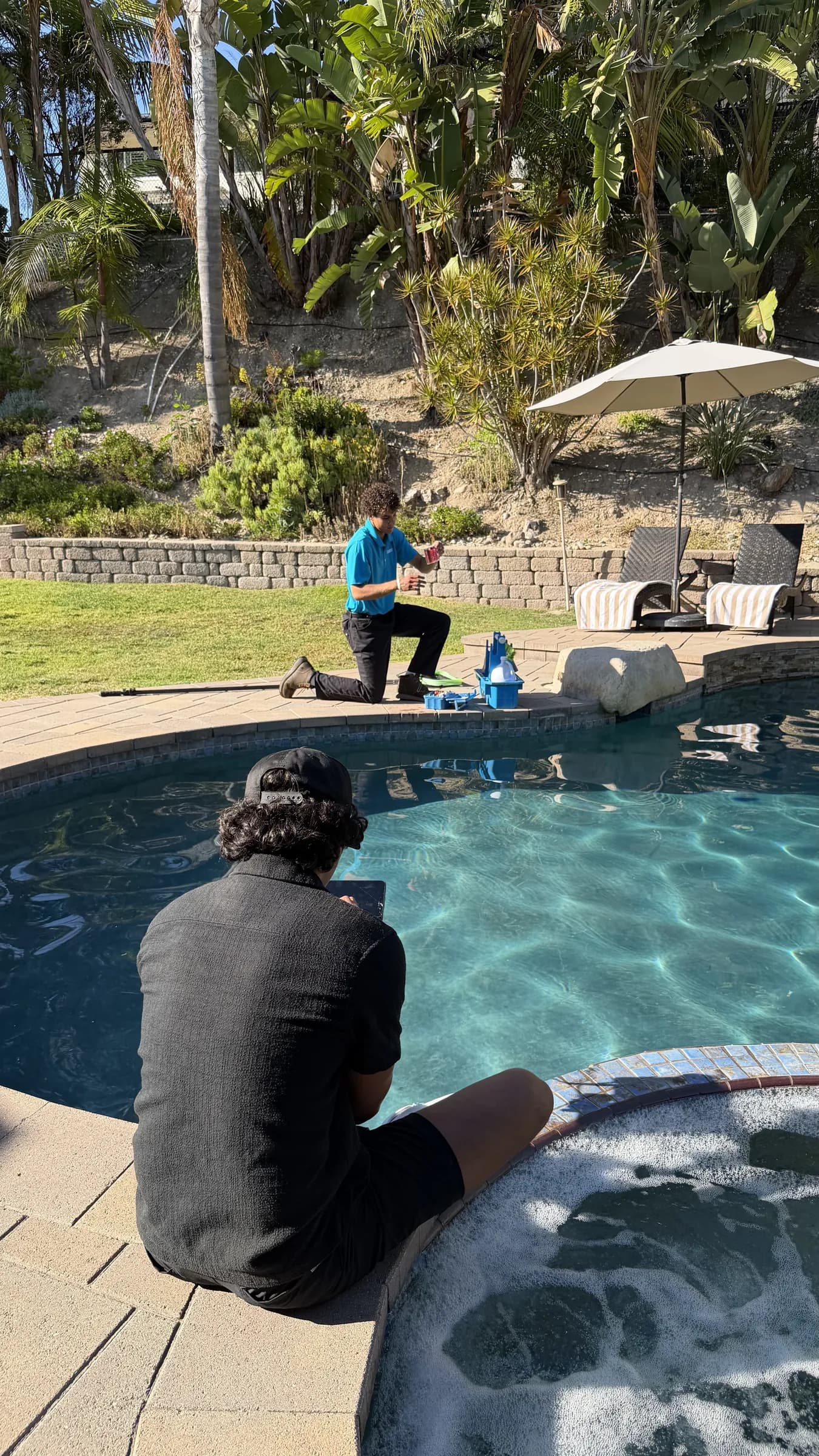
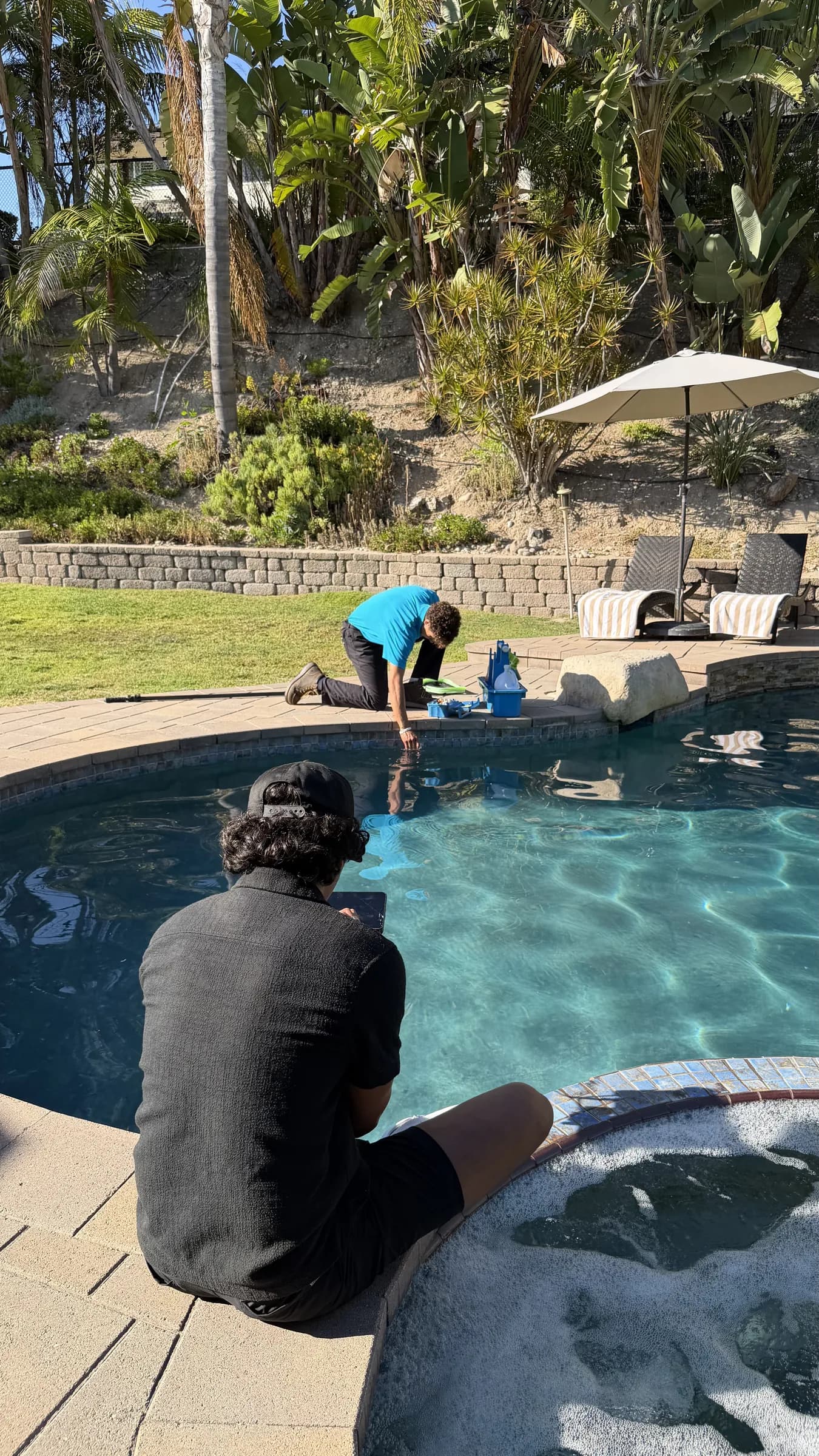
Before opening a container, spend ten minutes checking the water and equipment. We recommend this quick check because a low reading can call for a measured addition, a better test, or an equipment repair. Adding more without knowing which problem you have can leave the original problem unresolved.
Run these five checks before calling anyone
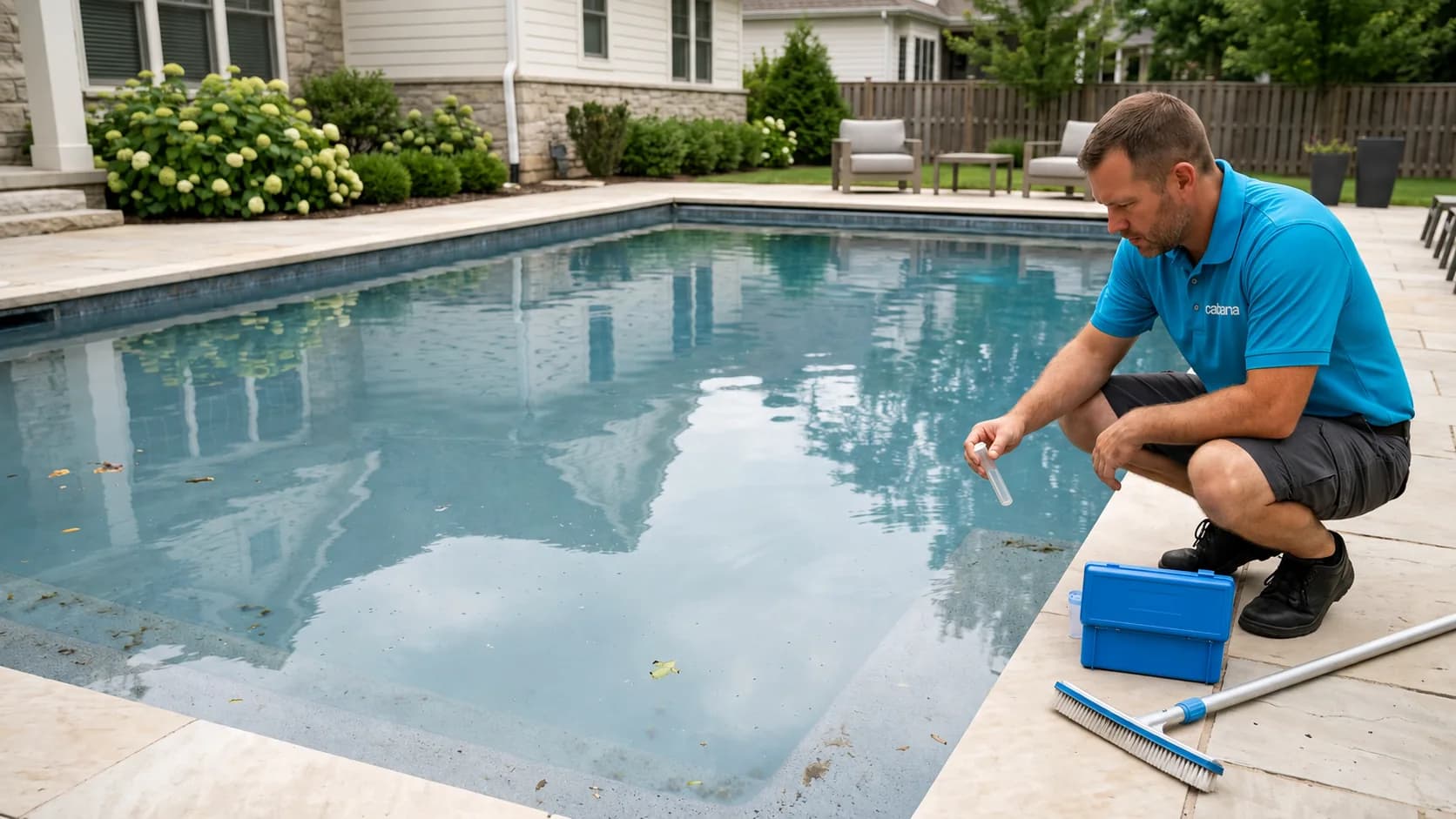
- Confirm the free chlorine reading. Test a sample from below the surface, away from return jets and chemical feeders. Use fresh reagents and follow the test instructions. If a strip reads zero after a recent large chlorine addition, confirm with a suitable drop test before adding more. Very high chlorine can bleach some tests and produce a misleading low result. A drop-count chlorine test, which measures chlorine by counting drops until a color disappears, can help confirm an uncertain reading.
- Check pH. A usual pool range is 7.2 to 7.8. Outside that range, water balance needs attention along with chlorine. If chlorine exceeds your pH test's stated limit, its pH result may be unreliable. Record the result rather than adding several corrective chemicals together.
- Find your stabilizer reading. Cyanuric acid, also called CYA or stabilizer, protects chlorine from sunlight. It also affects the free chlorine level needed. If you do not have a current result, get a CYA test before choosing a long-term chlorine target. A recurring low reading alone does not mean you need more stabilizer.
- Look for water returning to the pool. With the pump scheduled to run, check for normal flow at the returns. A stopped pump, persistent air in the pump basket, or little return flow means circulation needs attention before dosing. Do not keep running a pump that has lost its water supply.
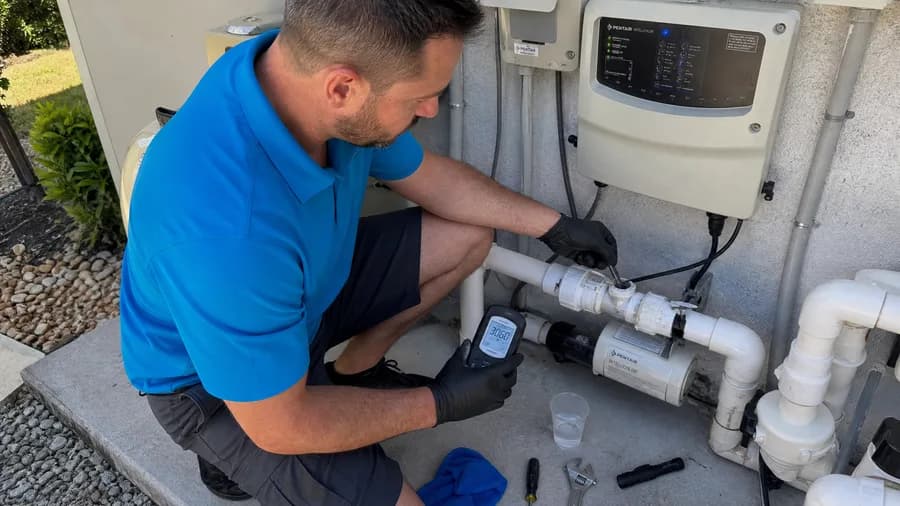
- Read the feeder or salt-system display. Check the schedule, output setting, and any warning message without opening equipment. A no-flow or cell warning means chlorine production may have stopped. Photograph the message for a technician.
This check should leave you with three useful answers: whether the reading is believable, whether water is circulating, and whether your usual chlorine source is operating. If the test cannot be confirmed or circulation is failing, arrange testing or service before making repeated additions.
Choose chlorine that fits your water
Read the active ingredient and concentration on the container. Products sold as chlorine or shock are not interchangeable, and some shock products contain no chlorine.
| Product | What it adds | Decision rule |
|---|---|---|
| Liquid pool chlorine, sodium hypochlorite | Chlorine without stabilizer or calcium | A practical choice for a measured correction when CYA or calcium is already high. |
| Calcium hypochlorite granules | Chlorine and calcium | Check calcium hardness before choosing it for repeated use. |
| Dichlor granules or trichlor tablets | Chlorine and stabilizer | Account for added CYA. Slow-dissolving tablets are not a quick correction. |
| Non-chlorine shock | An oxidizer, rather than a chlorine supply | Do not use it to replace a missing free chlorine dose. |
In San Diego, Los Angeles, and Orange County, hard source water and evaporation can leave pools with substantial calcium buildup. That makes the extra calcium from repeated calcium hypochlorite additions worth checking. Sacramento and East Bay source water is generally softer, but your pool's measured hardness should still guide the choice.
If testing confirms low stabilizer, our guide to raising cyanuric acid in your pool explains that separate adjustment. Do not add stabilizer simply because a hot afternoon used up more chlorine.
Choose a chlorine target and calculate the dose
Many pool chlorine labels specify a free chlorine range of 1 to 3 ppm; some specify a broader range. Read your product's range before choosing a target. For outdoor pools containing stabilizer, the CYA reading also matters.
A widely used maintenance guideline for manually chlorinated pools is to keep free chlorine at least roughly 7.5% of the CYA reading. Multiply CYA by 0.075: at 40 ppm CYA, that gives about 3 ppm free chlorine. At 60 ppm CYA, it gives about 4.5 ppm. This is a maintenance minimum, not an algae-treatment dose. Choose a dosing target above that minimum when your label permits, so normal daily losses do not immediately leave the pool short.
Salt-system manuals may specify different chlorine and CYA targets because the cell supplies chlorine throughout its operating period. Use your model's instructions alongside the sanitizer label. If the CYA-based minimum exceeds the label's operating range, arrange a water-balance check to address excess stabilizer rather than repeatedly dosing beyond the label.
Calculate the increase: Subtract your measured free chlorine from your selected target. For 10% liquid pool chlorine, an approximate dosing formula is 13 fluid ounces × the needed ppm increase × (pool gallons ÷ 10,000). Use the product's dosing table when available.
Example: A 10,000-gallon, manually chlorinated pool has 40 ppm CYA and 1 ppm free chlorine. Bringing it to 3 ppm, the guideline minimum at that CYA level, requires a 2 ppm increase. Using 10% liquid pool chlorine, the approximate dose is 26 fluid ounces. If the label permits a 4 ppm target, reaching that target instead requires about 39 fluid ounces and leaves some room for daily loss.
For the same 2 ppm increase in 20,000 gallons, the approximate dose doubles to 52 fluid ounces. A different product strength requires a different amount. Measure fluid ounces with a dedicated chemical measuring container.
Chlorine demand can make the actual increase smaller than calculated. Sunlight, debris, and contaminants consume chlorine while it mixes. Liquid chlorine also loses strength during storage, especially in heat. If the result falls short, verify the test, product strength, and pool volume before assuming a much larger dose is needed.
Add chlorine safely and retest after circulation
Keep swimmers out while adding chemicals. Wear the protection specified on the label, and use the label's application location and method with normal circulation operating. Do not pour chlorine into a skimmer unless the product and equipment instructions expressly permit it.
Never mix chlorine with acid or another chlorine product. Keep containers and measuring tools separate. Never pour liquid chlorine into a tablet feeder or put a different chemical into a feeder that held another product. Predissolve a product only when its label directs you to do so.
For liquid chlorine added with the pump running, retest after the water has circulated, typically 30 minutes to an hour, unless the label states otherwise. Keep the pump running during that mixing period. Sample away from the addition point and record the free chlorine result. For granular shock or other treatments, follow that product's circulation and retesting instructions.
Resume swimming only when the product's reentry requirements are met, chlorine and pH are within the applicable operating ranges, and the water is clear enough to see the bottom. The retesting interval is not automatic permission to swim.
Use the next reading to decide whether to call
- The reading rises and stays in range: Resume routine testing and adjust the normal feed schedule as needed. During inland heat or heavy swimming use, test daily and before swimming. Compare readings at roughly the same time each day to judge whether your routine supply is keeping up.
- The reading rises, then repeatedly drops below target: Record the dose, time, CYA, and next reading. Remove visible debris and arrange a chemistry check if the pattern continues. Santa Ana winds can add leaves and dirt quickly, increasing the material chlorine must handle. A substantial overnight drop without swimmers also warrants checking for contaminants rather than blaming sunlight alone.
- The reading barely changes after a verified dose: Arrange testing before repeating large additions. Our technicians can check chlorine demand, testing accuracy, and the chemical supply.
- The salt system shows a warning or produces too little: A salt pool still needs free chlorine. Adding salt does not directly correct a chlorine shortage, and increasing the output setting will not fix a failed cell or inadequate flow. We confirm the needed adjustment or repair after seeing the equipment through our salt water pool repair service.
- The water is green, slippery, or too cloudy to see the bottom: Keep swimmers out and arrange treatment. A routine chlorine top-up may not resolve an established algae problem.
Have your test results, approximate pool volume, chemical label, dose history, and equipment photos ready when you call. For recurring low readings, our weekly pool cleaning service can help manage testing, chemical adjustments, and routine equipment checks.