Backwash with the pump off between valve changes
To backwash a compatible sand or diatomaceous earth (DE) pool filter, stop the pump, select Backwash, then restart using the filter manufacturer's procedure. Stop the pump before every valve change, rinse if your model requires it, and recharge DE filters with the specified powder amount.
A common cleaning trigger is pressure rising 8 to 10 psi above the clean starting pressure, but your filter manual sets the threshold. Cartridge filters cannot be backwashed.
Our technicians first identify the filter, compare pressure under matching operating conditions, and check water flow. Those checks tell us whether backwashing will help or whether another restriction needs attention.
Identify the filter and valve before starting
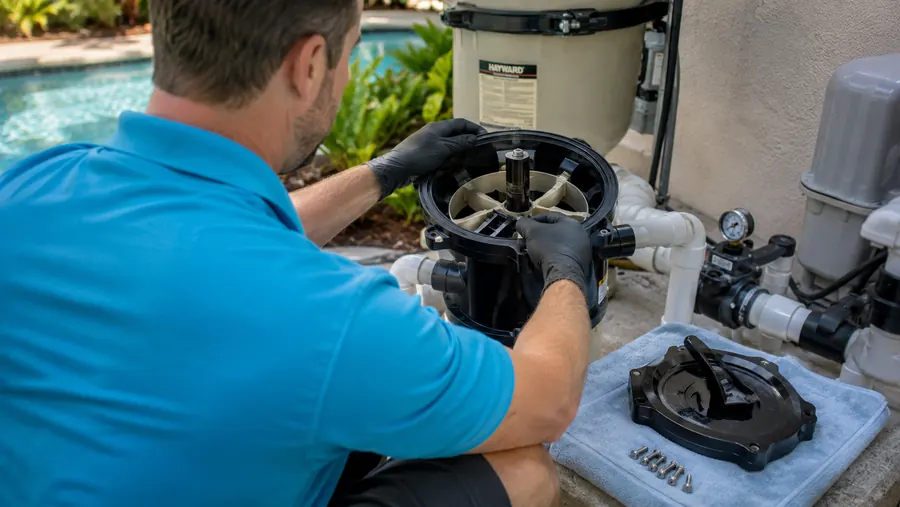
Read the filter's model label before moving a handle. A round tank alone does not identify the filter media. Confirm whether yours contains sand, DE grids or fingers, or cartridges.
- Sand filter with a multiport valve: Usually has Filter, Backwash, and Rinse positions. Follow the sequence below after checking its manual.
- DE filter with a backwash valve: Requires its model's backwash sequence and a measured DE recharge afterward.
- Push-pull valve: May have only filtering and backwashing positions. Do not look for a Rinse setting or copy a multiport handle sequence.
- Cartridge filter: Needs cartridge removal and cleaning instead. Use our guide to cleaning pool filters by equipment type.
Do not confuse Waste with Backwash. Waste sends water out without reversing flow through the filter media. If valve markings are unreadable or the handle will not move normally, stop and identify the valve before proceeding.
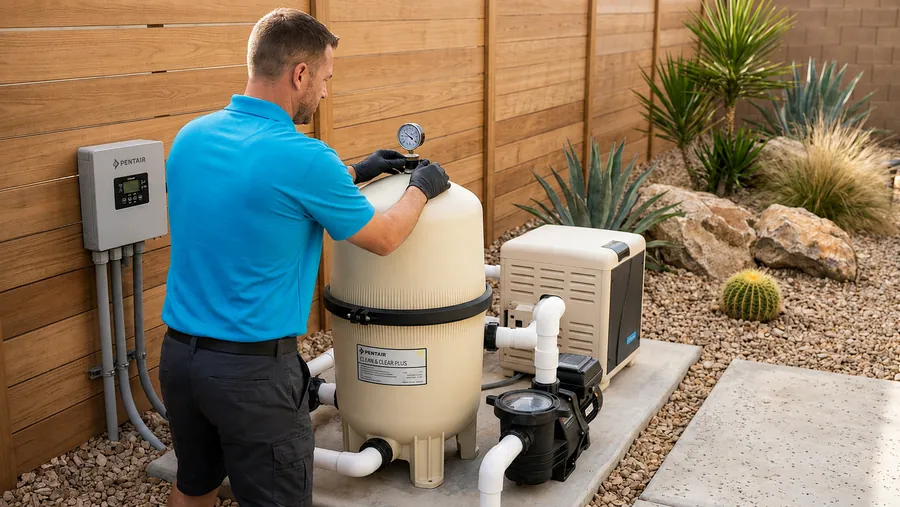
Compare pressure and flow to find the likely cause
Read the gauge at the same pump speed and valve settings used for your clean baseline. A higher speed can raise pressure without any additional dirt. Pool mode and spa mode can also produce different readings.
Across over 270 filter-pressure readings on our San Diego, Los Angeles, and Sacramento routes, the median was 20 psi. The middle 80 percent ranged from 10 to 30 psi. Use your own clean baseline to decide when to backwash; 20 psi alone is not a cleaning trigger.
| Reading or symptom | Likely cause to check | Next action |
|---|---|---|
| Pressure reaches the manual's cleaning threshold at the usual pump speed | Debris loading inside the filter | Backwash if the filter supports it. |
| Low pressure with weak returns or air in the pump basket | Low water level, a blocked basket, or a suction-side air leak | Check water supply and baskets before backwashing. |
| Pressure remains high immediately after backwashing | Incomplete cleaning, scale, or a restriction after the filter | Check valve positions and arrange inspection if pressure stays elevated. |
| Pressure returns near baseline, then rises quickly | Continuing debris load or, on DE equipment, a recharge problem | Check pool conditions and the specified DE dose. |
| Sand or DE appears at the pool returns | Possible internal filter damage or valve bypass | Stop repeated backwashing and have the equipment checked. |
| Gauge does not return to zero after shutdown and full depressurization | Possible faulty gauge | Verify the gauge before using its reading to schedule cleaning. |
For example, a filter with a clean baseline of 12 psi reaches an 8 psi rise at 20 psi. One starting at 20 psi does not reach that same rise until 28 psi. Always stay within the equipment's operating limits.
Prepare the water level, hose, and controls
Start with water near the middle of the skimmer opening. Backwashing removes pool water, and a falling level can let the pump draw air. Stop if the skimmer starts pulling air or the pump loses prime.
Switch off the heater and follow its required cooldown procedure before stopping circulation. Disable scheduled or remote pump starts while handling the valve. Keep the filter tank closed; ordinary backwashing does not require loosening its clamp or lid.
Secure the backwash hose and lay it out without kinks. Confirm an approved discharge destination with your local wastewater authority before starting. DE backwash also carries filter powder, so ask about solids handling. Do not assume a nearby drain is an acceptable outlet.
Backwash a sand filter through its multiport valve
- Stop the pump. Wait until it has fully stopped before touching the valve.
- Select Backwash. Fully depress the multiport handle, move it to Backwash, and release it into position.
- Restart at the recommended backwash speed. A low everyday filtration speed may not provide enough flow to clean the sand bed.
- Watch the sight glass or discharge. Many sand filters take about 2 to 3 minutes to clear. Use the manufacturer's endpoint and keep watching the pool water level.
- Stop the pump and select Rinse. Restart for the specified rinse interval, commonly 20 to 30 seconds. Rinsing settles the sand and sends remaining dirty water out.
- Stop the pump and return to Filter. Restart at the usual filtration speed, then check pressure, return flow, and the waste outlet for leakage.
If the discharge never clears, stop and investigate instead of extending the cycle indefinitely. A kinked hose, unsuitable flow rate, or heavy debris load can prevent an effective backwash.
Recharge a DE filter using its backwash dose
DE filters need their own sequence. Some require repeated short backwash cycles, while others specify a different procedure. Use Rinse only if the valve has that setting and the filter instructions call for it.
Before starting, find the manufacturer's DE amount for recharging after backwashing. That amount may differ from the charge used after completely cleaning the grids. Do not guess from tank size or use an unmarked scoop.
After completing the specified cycles, stop the pump and return the valve to Filter. Restart and promptly add the measured DE slurry through the designated skimmer as instructed. Do not leave a DE filter running without its required coating. Avoid breathing dry powder and follow the product's handling directions.
If DE returns to the pool, stop adding more and have the filter inspected. A damaged grid, manifold problem, or valve fault may need repair.
Use the next pressure reading to choose your next step
Once circulation is steady, record the pressure at your normal pump speed. Pressure near the established clean baseline, stronger returns, and no waste-line leakage indicate that the cycle helped. Persistently high pressure calls for another check, not automatic repeated backwashing.
In Southern California, hard source water and evaporation can contribute to mineral deposits that backwashing does not remove. If pressure stays elevated after a correct cycle, our technicians check for deposits and other restrictions before choosing a cleaning method.
After Santa Ana winds load a pool with dust and leaves, empty the baskets and check pressure sooner than usual. Backwash when the reading reaches the equipment's threshold rather than adding a fixed weekly cycle.
If pressure will not recover, powder or sand reaches the returns, or the valve leaks to waste, arrange pool filter cleaning and an equipment assessment. Have the model number, clean baseline, current pressure, and pump speed ready so we can narrow down the next check.