Use replacement ranges to plan, then check condition
Replace pool filter parts when they are damaged or proper cleaning no longer restores performance; for planning, estimate 2 to 4 years for cartridges, 5 to 7 years for sand, 5 to 10 years for DE grids, and 10 to 15 years for the tank. These are estimates, not deadlines: your equipment manual overrides them, and inspection and pressure readings determine actual timing.
Most California pools run equipment twelve months a year. Their filtering parts get more use than those in pools closed for winter. Keep replacement dates alongside cleaning records so you can judge age against actual performance.
What you call the filter can mean two different things. The tank is the outer housing. Inside it, the filtering material, also called media, catches dirt. Replacing a cartridge or changing sand does not automatically mean replacing the tank.
| Part | Planning estimate | What decides replacement |
|---|---|---|
| Full-size pool filter cartridge | 2 to 4 years | Torn fabric, damaged ends, collapsed pleats, or restriction that remains after proper cleaning |
| Conventional filter sand | 5 to 7 years | Poor filtering that persists after checking backwashing, deposits, valves, and internal parts |
| DE grids | 5 to 10 years | Torn fabric, broken supports, or other damage that lets dirt escape |
| Filter tank | 10 to 15 years | Housing condition, availability of suitable parts, and compatibility with the pump and plumbing |
Smaller cartridges can need replacement much sooner. Sound equipment may remain usable beyond these estimates, while damage can require replacement earlier.
Find out what kind of filter you have
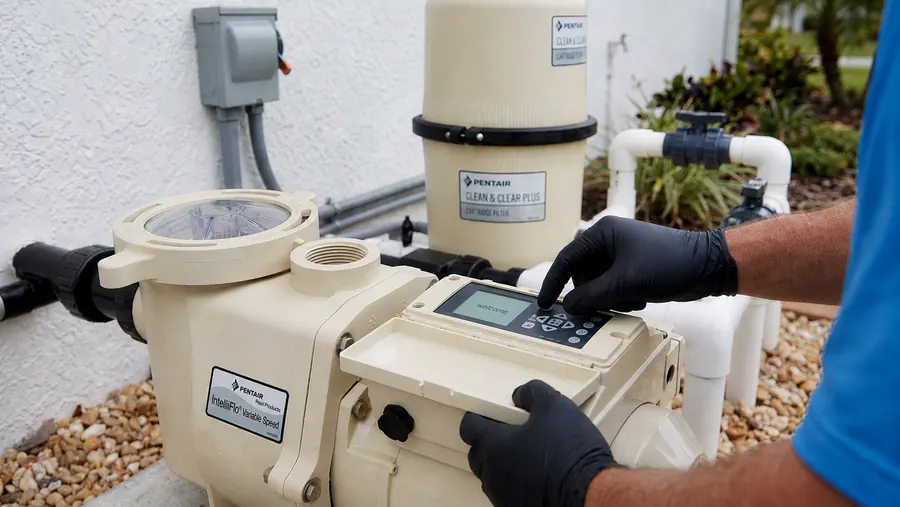
Check the model label before ordering parts or choosing a cleaning method. A cartridge filter uses pleated elements. A sand filter traps debris in a bed of sand. A DE filter uses diatomaceous earth, a fine filtering powder, over fabric-covered grids or other supported elements.
DE powder and DE grids have different replacement schedules. Replenish powder according to the equipment instructions after cleaning or backwashing. The multi-year estimate applies to the supporting grids, not the powder. Backwashing reverses water flow through a compatible filter to flush out trapped dirt.
Inspect the outside before checking operating pressure. A leak at a seal may need a seal replacement. If the tank is cracked or the lid or clamp is damaged, stop running the pump. That part, or the whole filter, may need replacing.
If water sprays from the lid or the clamp looks displaced, turn the pump off and keep clear. Never loosen a clamp while the system is pressurized. Before opening any filter, shut off power, prevent automatic starts, and release pressure according to its manual. A zero gauge reading alone does not replace that procedure.
Compare today's pressure with your clean reading
Follow your manual; many filters call for cleaning around 8 to 10 psi above the clean reading. If your clean reading is 12 psi and your manual specifies a 10 psi rise, clean at 22 psi. That reading calls for cleaning or backwashing, not automatic replacement.
Your clean reading is the pressure recorded after proper cleaning, with normal water flow and trapped air released as directed. Compare readings at the same pump speed and valve settings. A higher pump speed can raise pressure without adding dirt to the filter.
Check whether the gauge returns to zero when the system is off and fully depressurized. A stuck gauge makes comparisons unreliable. If you do not know the clean reading, record one after servicing the equipment. There is no single normal pressure for every pool.
Weak water from the return jets does not prove the filter is worn out. Check the pool water level and skimmer and pump baskets. Too little water reaching the pump can produce weak flow with low filter pressure. Use our filter cleaning guide by equipment type before choosing the next maintenance step.
Use pressure and escaping debris to choose your next check
Read pressure alongside water flow and what comes out of the return jets. The combination helps distinguish a dirty filter from damaged parts or a problem elsewhere in the equipment.
| What you notice | What it can mean | What to check next |
|---|---|---|
| Pressure stays high immediately after proper cleaning. | Deposits remain, filtering material is restricted, or something is blocking water on its way back to the pool. | Check the media, gauge, and the valves on the pipes returning water to the pool. |
| Pressure is low and return jets remain weak after clearing baskets. | The pump may be receiving too little water or drawing air. | Have the pump, incoming water pipes, and valve positions checked. |
| Dirt returns to the pool despite normal pressure. | Water may be passing through damaged material or around an internal seal. | Inspect cartridges, grids, seals, and connections for a gap that lets dirty water slip past the filter. |
| Sand or DE powder comes out of the return jets. | An internal part may be damaged or incorrectly assembled. | Check sand-filter laterals, the small slotted collectors inside the tank, or DE grids and their connections. |
| Pressure rises again soon after cleaning. | Heavy debris, algae, deposits, or a filter that is too small may be shortening the cleaning cycle. | Check water condition and debris load before blaming the media's age. |
| The pool stays cloudy while pressure and flow look normal. | Water chemistry or fine suspended debris may be involved. | Test sanitizer and water balance, then check whether the filter captures debris. |
Santa Ana winds can load a Southern California pool with dust and leaves in a day. A short cleaning cycle after that event does not establish that the filter needs replacement. Cleaning intervals that keep shrinking under otherwise similar conditions deserve closer inspection.
Look for damage after cleaning
For a cartridge filter, torn fabric, separated end caps, or collapsed pleats call for replacement. A cartridge that remains restricted after appropriate cleaning may also need replacing. Staining alone does not establish failure. Our guide to how long a pool filter cartridge lasts covers cartridge-specific wear.
For a sand filter, look for hardened clumps and channels that let water pass without filtering effectively. Sand returning to the pool also calls for checking internal collectors. Fresh sand will not fix a broken collector.
For a DE filter, inspect the fabric and supporting parts for tears, breaks, and loose connections. A damaged grid may be replaceable separately. Verify the correct powder amount for the model and cleaning method. Adding more powder will not fix torn fabric.
Hard, mineral-heavy Southern California water can leave calcium deposits, especially as evaporation concentrates the water. A stiff cartridge or chalky coating calls for checking calcium hardness and pH. Use only a cleaning treatment permitted by the manufacturer, then reassess flow and physical condition. A rinse alone may not remove those deposits.
Sacramento and East Bay source water is generally softer, so do not assume the same buildup everywhere. Test the pool before choosing a treatment. Correcting water balance also helps prevent the replacement material from developing the same deposit problem.
Choose cleaning, part replacement, or a new filter
After cleaning, recheck pressure and return flow at the original pump settings. Use the result to choose the work needed:
- Keep the existing filter when cleaning restores expected pressure and flow, and its internal parts remain intact.
- Replace filtering material or damaged internal parts when inspection finds damage or persistent restriction inside an otherwise sound tank.
- Consider a whole-filter replacement when the tank is unsafe, essential replacement parts are unavailable, or the filter is too small for your pump and plumbing.
Match replacement parts to the model and manufacturer's specifications. Cartridge dimensions alone do not establish compatibility. A complete replacement must also suit the plumbing and water flow. We confirm those details after seeing the equipment.
Call for service if cleaning does not restore performance, debris keeps returning, or the tank or closure shows damage. Photograph the model label and gauge without opening the tank. Note the pump speed, clean reading, last cleaning date, and when the problem began. These details help our technicians identify the next check.
For cleaning or help establishing a clean reading, see our pool filter cleaning service and pricing details. Filter type, access, deposits, and internal condition affect the work involved. For damaged components, see our pool filter repair service.