Plan for 2 to 4 years, then judge its condition
A pool filter cartridge often lasts about 2 to 4 years, depending on use, cleaning, and water conditions. Replace it sooner if the fabric tears, the ends crack, or proper cleaning no longer restores normal water flow.
That lifespan refers to the removable pleated insert, not the entire filter tank. An aging cartridge alone does not mean the housing needs replacement. The cartridge manufacturer's guidance takes priority over a general age estimate.
Most California pools run equipment twelve months a year. A cartridge serving a year-round pool gets more use than one serving a pool closed each winter. Treat its installation date as a planning tool, then use its condition and performance to decide.
| Choice | When it makes sense | What to check |
|---|---|---|
| Keep using it | The fabric and ends are intact, flow is normal, and pressure stays near its clean reading. | Compare readings at the same pump speed. |
| Clean it | Pressure reaches the manufacturer's cleaning threshold, but the cartridge has no damage. | Many filters call for cleaning around 8 to 10 psi above clean pressure. |
| Replace it | The fabric tears, the ends split, or buildup remains after appropriate cleaning. | Confirm the correct replacement part and rule out another flow problem. |
Keep it when pressure and water flow stay normal
A cartridge does not expire on its second birthday. If it remains intact and performs normally after cleaning, age alone is not a reason to discard it. Equally, a relatively new cartridge with a torn pleat needs replacement.
Your most useful reference is clean starting pressure, the gauge reading after a thorough cleaning with normal circulation restored. Record that number alongside the date and pump speed. There is no single correct pressure for every pool because plumbing, pump settings, and filter size differ.
For example, if your clean reading is 12 psi and your manual specifies cleaning at a 10 psi increase, the trigger is 22 psi. That example is a comparison rule, not a recommended operating pressure for your pool.
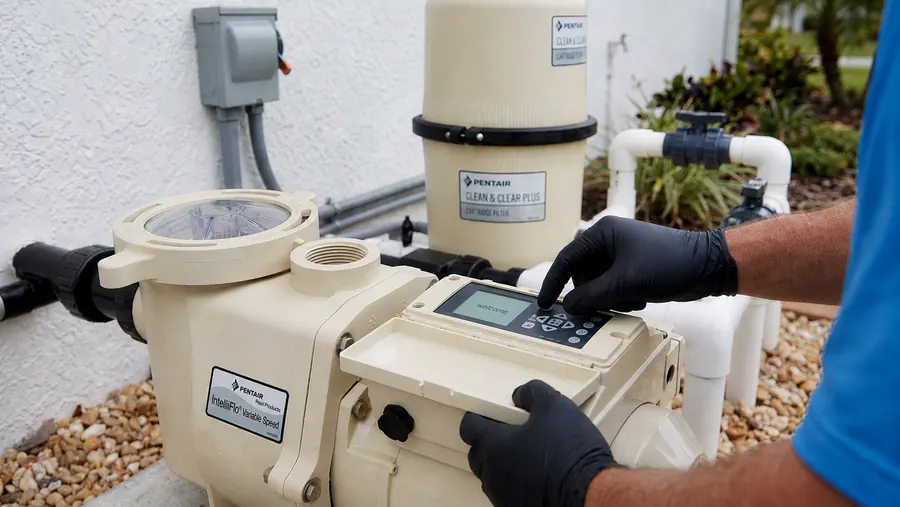
With a variable-speed pump, compare readings at the same speed and valve settings. A higher speed can raise pressure without any change in cartridge condition. Comparing an afternoon high-speed reading with a morning low-speed reading can make a sound cartridge look clogged.
Keep a short record of cleaning dates and pressure afterward. The useful pattern is whether cleaning repeatedly restores the usual reading. Brown or gray staining alone does not prove the fabric has stopped filtering.
Clean it when dirt restricts flow but the fabric is sound
Clean the filter when it reaches the threshold in its manual. Many cartridge filters use an increase of about 8 to 10 psi over clean pressure. Follow any scheduled inspection or cleaning interval the manufacturer also specifies.
A dirty cartridge and a worn cartridge can both cause trouble, but cleaning helps distinguish them. If cleaning restores normal pressure and circulation, and the pleats remain sound, you can usually keep using it.
Southern California's Santa Ana winds can load a pool with leaves, dust, and pollen in a day. Check baskets and filter pressure after a wind event instead of assuming an early pressure increase means the cartridge is worn out. Heavy debris can shorten the time between cleanings without ending the cartridge's useful life.
Hard source water in San Diego, Los Angeles, and Orange County adds another concern. Evaporation concentrates minerals, and calcium deposits can stiffen or coat the pleats. If rinsing leaves a hard, chalky coating, identify the deposit before choosing a treatment. Softer source water around Sacramento and the East Bay makes it especially unhelpful to assume every flow problem is calcium buildup.
Use a garden hose and cleaning products approved for the cartridge. A pressure washer can damage the fabric. Avoid household dish soap, which can leave foaming residue, and do not improvise chemical mixtures.
Before opening the housing, turn off the pump, disable automatic starts, and release pressure according to the manual. Never loosen the clamp while the tank is pressurized. Our guide to cleaning pool filters safely by equipment type explains the cleaning process.
Replace it when damage or lasting restriction remains
Replace the cartridge when you find torn fabric, split end caps, a damaged center support, or pleats that have collapsed together. The pleats are the folded fabric that catches debris. Damage can let dirt pass through or reduce the area available for filtration.
Low pressure does not prove a damaged cartridge is working. Water may pass through a tear instead of through the fabric. Inspect the cartridge even if the gauge looks normal when dirt keeps returning to the pool.
Persistent high pressure after cleaning also deserves investigation. First confirm that the comparison uses the same pump speed, the gauge works, and the valves are correctly positioned. Weak return flow can have other causes, including blocked baskets or a pump problem. Replacing the cartridge will not correct those.
When the equipment checks out but embedded deposits remain and normal flow does not return, replacement is a reasonable next step. Our technicians check the cartridge and circulation before recommending that change.
Match the replacement to the filter model and approved part number. Similar-looking cartridges can have different lengths, end openings, and sealing surfaces. Those differences matter because water must pass through the fabric rather than around it.
For a tank containing several cartridges, inspect every element. If all were installed together and show similar wear, replacing the set can make sense. One damaged element still warrants checking for a fit or support problem before fitting another.
Use your next cleaning to make the replacement decision
If you do not know the cartridge's age, start with its condition rather than guessing a replacement date. At the next cleaning, collect these details:
- The filter model and cartridge part number.
- Pressure before cleaning, with the pump speed recorded.
- Any torn pleats, cracked ends, or deposits that remain.
- Pressure after cleaning at the same operating settings.
If the cartridge is intact and pressure returns to its usual level, keep it in service. If visible damage remains, replace it. If pressure or flow stays abnormal without obvious damage, have the equipment checked before buying parts.
For help making that call, see our pool filter cleaning service and pricing details. The work depends on the filter model, number of cartridges, buildup, and condition. We confirm whether cleaning or replacement makes sense after inspecting the equipment.