The salt cell turns dissolved salt into chlorine
A salt water pool makes its own chlorine. Electricity passes through a salt cell and turns dissolved salt, usually about 3,000 to 3,500 ppm, into chlorine.
Ppm means parts per million, a measure of concentration. Your salt system's manual sets its required range, which may differ from this common range. Ocean water contains about 35,000 ppm of salt, so a salt pool is much less salty.
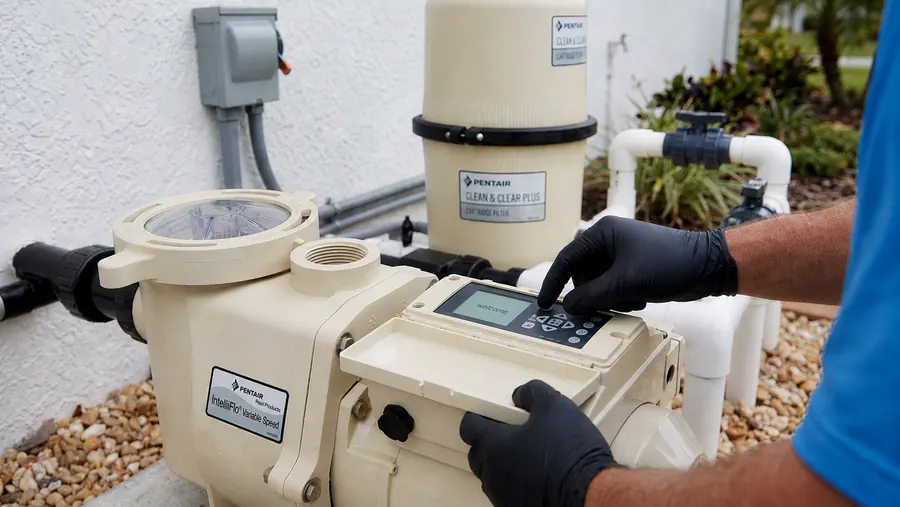
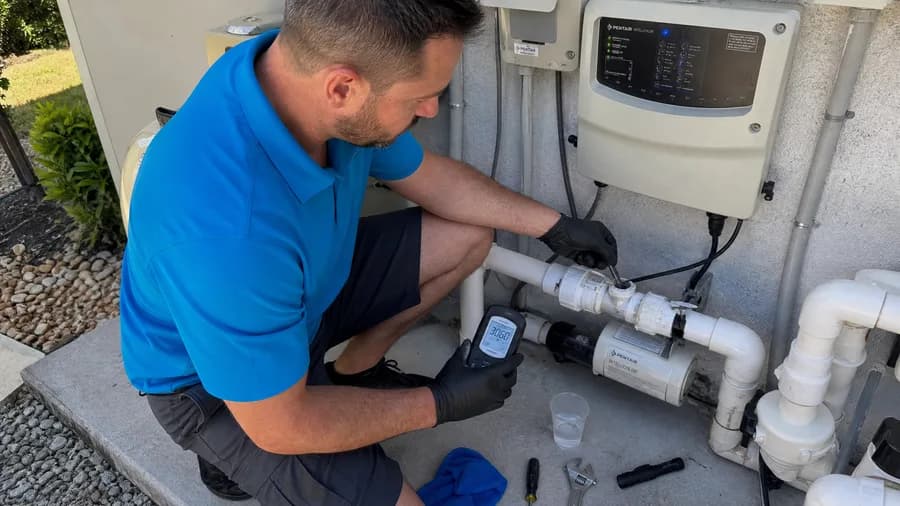
The chlorine generator has a control unit and a salt cell fitted into the return plumbing. Inside the cell, electrically charged plates convert chloride from dissolved salt into chlorine. This process is called electrolysis. In water, that chlorine forms hypochlorous acid, the same disinfectant produced by conventional pool chlorine.
Much of the chlorine eventually returns to chloride after reacting or breaking down. The cell can use it again. Salt alone does not sanitize the pool, and a salt pool still contains chlorine.
The equipment has separate jobs:
- The pump moves water through the equipment and back into the pool.
- The filter traps particles that chlorine cannot remove.
- The salt cell produces chlorine while operating conditions allow it.
- The control unit sets production and reports conditions such as low salt or insufficient flow.
Choosing salt changes how chlorine reaches the water. You still need circulation, filtration, brushing, and water testing.
The output percentage controls production, not chlorine level
The output percentage tells the cell how much of its running time to spend making chlorine. On many systems, a 50% setting means production runs for about half of each operating cycle. It does not mean the pool contains a particular chlorine level.
For example, if the pump runs eight hours with enough flow for the cell to work, a 50% setting makes chlorine for about four of those hours. That example explains the setting; it is not a recommended daily schedule. Actual production depends on the cell's capacity, water temperature, salt level, flow, and condition.
Most home salt systems do not automatically measure free chlorine, the chlorine available to sanitize the water. A panel can show normal operation while the pool uses chlorine faster than the cell produces it.
Use a water test to decide whether output needs changing. Compare readings taken at a similar time each day, then adjust one setting at a time. Retest after the adjustment has had time to affect the pool.
A variable-speed pump must provide enough flow for the cell to operate. A running pump does not always mean the cell is generating chlorine. Once flow is adequate, increasing pump speed alone does not necessarily increase chlorine production. Check the output setting and hours of generation before raising pump speed.
The flow switch should stop production when flow is inadequate; never bypass it. The cell also produces hydrogen gas, which must not collect in stagnant plumbing.
If the pool needs a different circulation schedule, our guide to how long a swimming pool pump should run explains the factors to weigh.
Keep pH between 7.2 and 7.8 and test beyond salt
Keep pool pH between 7.2 and 7.8; a salt generator does not control it automatically. Salt pools often experience rising pH, partly because gas bubbles produced during operation help carbon dioxide leave the water.
High pH can encourage calcium deposits inside the cell. Low pH can make water corrosive. Correct pH based on a measured result and the chemical label, rather than adding a fixed amount each week.
Test free chlorine and pH at least twice weekly during normal use. For pools using stabilizer, which protects chlorine from sunlight, maintain at least 2 ppm free chlorine. Treat that as a minimum, not a universal target. Higher stabilizer levels can require higher chlorine targets. Follow the equipment guidance and a chlorine target appropriate for the measured stabilizer level.
| Reading | What it tells you | What to do with it |
|---|---|---|
| Free chlorine | How much sanitizer remains available | Use it to judge whether production matches demand. |
| Salt | Whether salt concentration suits the generator | Compare an independent test with the panel before adding salt. |
| Stabilizer, also called cyanuric acid | How much protection chlorine has from sunlight | Use the manufacturer's range and coordinate the chlorine target with it. |
| Alkalinity | How strongly the water resists pH changes | Check it when pH repeatedly drifts. |
| Calcium hardness | How much dissolved calcium the water contains | Evaluate it with pH, alkalinity, and temperature before adjusting. |
Low chlorine does not automatically call for more stabilizer. Test stabilizer first: adding it when the level is already high can make the chlorine shortage harder to correct.
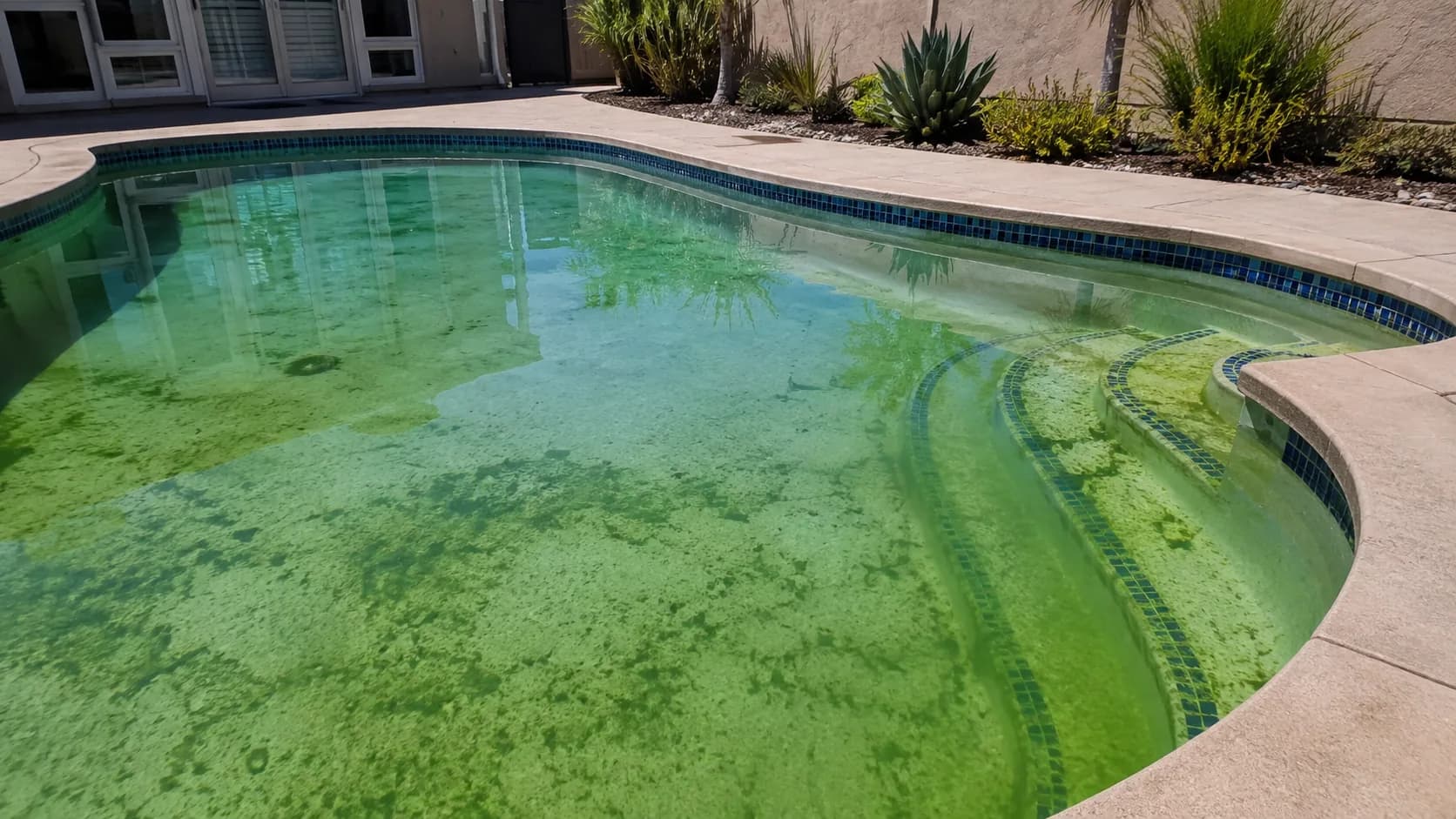
A salt reading cannot replace these tests. Clear-looking water also cannot establish that enough sanitizer is present.
California heat and source water change the settings
Sacramento Valley summer days often exceed 100°F, so chlorine demand deserves closer attention during hot spells. Hot inland Southern California pools also lose more water to evaporation and can need more chlorine production than cooler coastal pools.
Coastal May and June mornings often stay gray under the marine layer. A setting that maintains chlorine during gray weather may fall behind when sunshine and heat return. Check chlorine more often during heat, heavy swimming, or sudden weather changes.
Santa Ana winds bring another change: leaves, dirt, and pollen can enter a pool in a day. Remove debris promptly and test chlorine after the wind. Raising cell output alone leaves that material in the water.
Source water changes the balance work, too. San Diego, Los Angeles, and Orange County commonly receive hard, mineral-heavy water. Evaporation followed by repeated top-ups can concentrate calcium, increasing the chance of hard white calcium buildup (scale) on the cell plates when pH and calcium run high.
White crust on the plates calls for inspection and a water-balance check. Follow the cell manufacturer's cleaning instructions. Do not acid-clean a cell just because chlorine is low; unnecessary acid exposure can shorten the life of its coating.
Sacramento-area and East Bay supplies are generally much softer. Test calcium hardness before copying a Southern California chemical routine. Soft fill water may need calcium adjustment, depending on the pool and its overall water balance.
During cooler months, many generators reduce or stop production below a model-specific water temperature. If the panel reports cold water, consult its temperature threshold and keep testing chlorine even when the pool sees little use.
Evaporation does not mean you need more salt
Water that evaporates leaves its salt behind, so evaporation alone never calls for more salt. Restore the normal water level before deciding whether the salt concentration needs adjustment.
Salt does leave when pool water leaves through splash-out, leaks, or filter backwashing. Backwashing means sending water backward through a compatible filter to flush trapped dirt. Rainfall and fresh water replacing lost pool water can dilute the salt concentration.
A low-salt warning is a reason to test, not an instruction to pour in a bag. Cold water, deposits on the cell, or a sensor problem can affect the displayed reading. Adding salt without confirmation can leave the pool above the equipment's operating range.
When a separate test confirms low salt, calculate the addition from pool volume and the measured shortfall. Use the salt type specified by the manufacturer. Follow its directions for dissolving and circulating the salt before restarting generation.
Retest after the specified mixing period before adding another dose. An early reading may not reflect the full addition, especially while salt remains undissolved.
The generator does not consume salt like a feeder consumes chlorine tablets. If repeated tests show salt falling unexpectedly, investigate where pool water is being lost.
Use three checks when chlorine falls
When chlorine falls, three checks help separate a settings problem from an equipment problem: test the water, read the panel, and check circulation.
- Test the water. Measure free chlorine, pH, stabilizer, and salt. If chlorine is below the appropriate target, keep swimmers out until the water is corrected. Also keep swimmers out if cloudy water hides the pool bottom.
- Read the panel. Record the output setting and any salt, temperature, flow, or cell warning. A boost setting usually extends generation at maximum output; it does not prove the pool has reached a safe chlorine level or restore sanitizer immediately.
- Check circulation. Check the water level and accessible baskets. Note weak return flow or unusual filter pressure. Turn equipment off before opening pump or filter components, and follow the manufacturer's pressure-release instructions.
If circulation is normal and the water readings suit the generator, continued chlorine loss may reflect high demand or reduced cell production. Do not replace the cell based only on a low chlorine reading.
Routine adjustments make sense when tests identify the problem and the equipment operates normally. Persistent warnings or chlorine that stays low despite suitable settings call for equipment testing.
Our technicians check water balance, operating conditions, controls, and cell performance to identify the cause. Use our salt water pool repair service when warnings persist or production cannot maintain the appropriate chlorine level. Have the system model, pump schedule, recent test results, and warning message ready.