What chlorine lock means when chlorine seems to stop working
Chlorine lock in a pool is an informal name for chlorine that seems ineffective, not a separate chemical condition. The usual checks are for excess stabilizer, contamination using chlorine up, or equipment failing to supply enough chlorine.
You might see green water despite a chlorine reading, or find that yesterday's chlorine has disappeared. Those situations need different checks. Free chlorine measures chlorine available for disinfection. Stabilizer, also called cyanuric acid or CYA, protects chlorine from sunlight but reduces its immediate disinfecting strength at the same free chlorine reading.
There is no single stabilizer number where chlorine suddenly switches off. Likewise, a zero chlorine reading doesn't prove stabilizer is high. Chlorine demand means contaminants are consuming chlorine, sometimes faster than your normal treatment replaces it. More than one problem can occur together.
Use these readings to separate the three problems
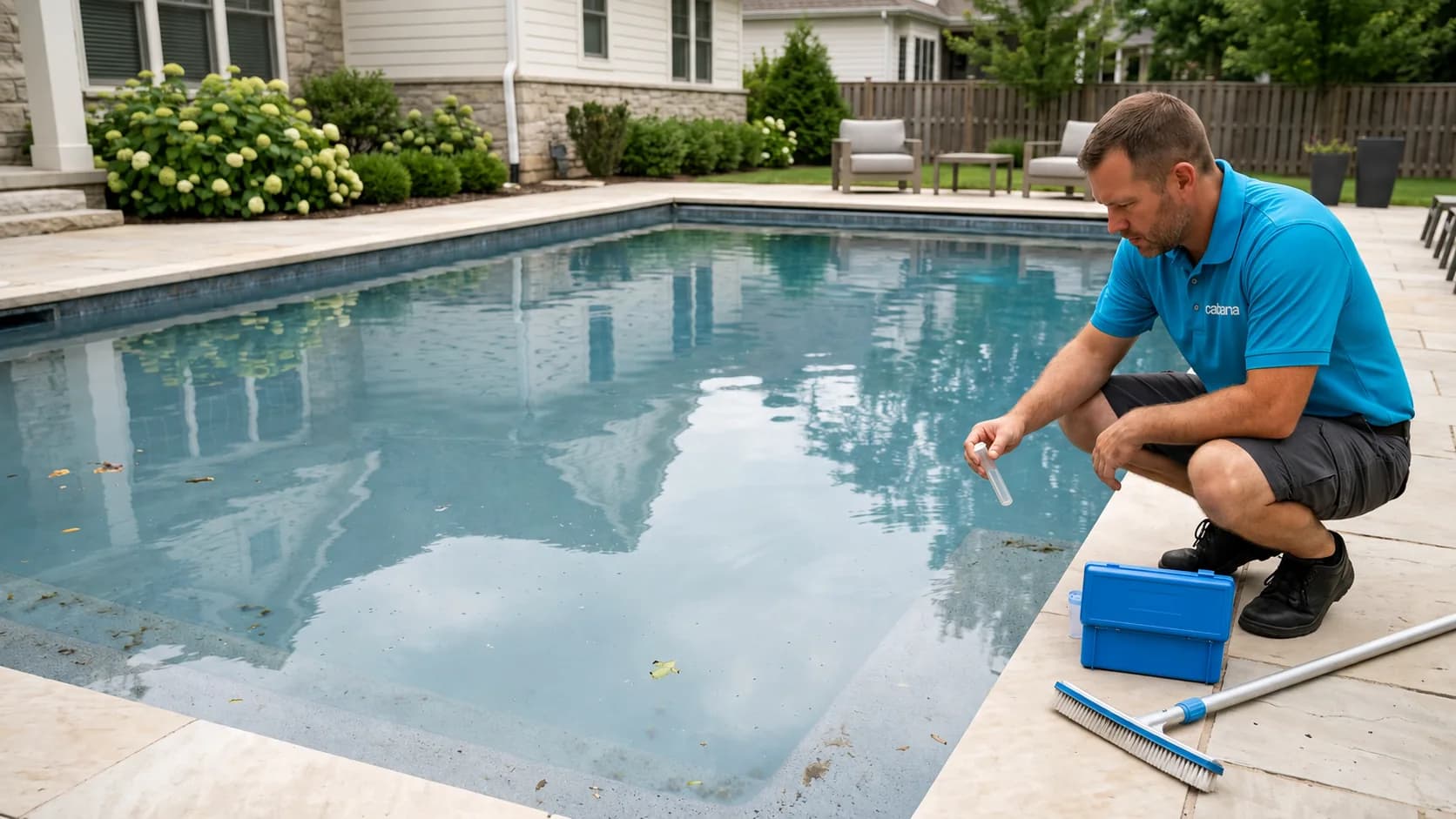
Record free chlorine, total chlorine, pH, and CYA together. Results in ppm mean parts per million. Use a kit that measures free chlorine separately, and sample away from return jets according to its instructions.
As general industry guidance, outdoor pools chlorinated with tablets commonly use a CYA range of 30 to 50 ppm. Many salt pools use 60 to 80 ppm, subject to the salt system's manual. Tablets keep adding CYA, so a pool within range today can exceed it with continued use.
A commonly used rule of thumb for manually chlorinated outdoor pools is to keep free chlorine at least roughly 7.5% of CYA. At 80 ppm CYA, that means about 6 ppm free chlorine. Leave room above that minimum for daily chlorine loss. This is a maintenance guideline, not an algae treatment dose or permission to exceed a product label. Salt systems can have different operating guidance because they produce chlorine throughout their operating cycle.
| What you notice | What to check | What the result suggests |
|---|---|---|
| Algae persists despite measurable chlorine | Compare free chlorine with CYA and inspect circulation | Chlorine may be inadequate for the stabilizer level, even though the test shows a reading. |
| Chlorine falls after leaves arrive or algae appears | Check debris, free chlorine, and total chlorine | Contamination may be consuming chlorine faster than it is replaced. |
| Chlorine stays low despite the normal equipment schedule | Check feeder contents, flow, and salt system warnings | The pool may not be receiving enough chlorine. |
| Chlorine reads zero immediately after a large addition | Confirm with a test suitable for the expected concentration | The test may be giving a false low result. |
Total chlorine includes free chlorine plus combined chlorine, chlorine that has reacted with contaminants. Subtract free chlorine from total chlorine to calculate combined chlorine. For example, total chlorine of 4 ppm and free chlorine of 1 ppm means combined chlorine is 3 ppm. That calls for investigation, but doesn't measure stabilizer or determine a shock dose by itself.
Some color-based chlorine tests can falsely read low above 10 ppm. Very high chlorine can also interfere with some pH tests. Follow the kit's instructions for these conditions rather than improvising a dilution.
Keep pH within 7.2 to 7.8, and assess free chlorine alongside CYA rather than relying on a single chlorine minimum. Our guide to cyanuric acid and chlorine effectiveness explains the relationship further.
If stabilizer is high, stop adding it and plan water replacement
Check whether your tablets or shock contain stabilizer, and whether part of the water needs to be drained and refilled to bring CYA down. Trichlor and dichlor add stabilizer along with chlorine. Repeated doses can raise CYA even when you never buy a separate stabilizer product.
When CYA exceeds the appropriate range, partial water replacement lowers it by draining part of the pool and refilling with fresh water containing less CYA. Evaporation followed by topping up doesn't remove accumulated stabilizer. Don't assume rain corrected it either: retest after the water has mixed.
For a simple dilution example, replacing half the water with CYA-free water would roughly reduce 100 ppm CYA to 50 ppm. This assumes water is removed before refilling and mixes fully afterward. It is an estimate, not an instruction to drain half your pool. Several smaller exchanges require more total replacement water because each exchange also removes some previously added fresh water.
If CYA exceeds your test's scale, get a measured result before calculating replacement. We confirm the plan after checking the pool, equipment, and water readings. Arrange pool water replacement and restart service before lowering the water yourself.
If chlorine keeps disappearing, remove debris and treat the demand
Check that your feeder or salt system is actually adding chlorine, and look for leaves, algae, or other debris using it up, before blaming stabilizer. Santa Ana winds can load Southern California pools with leaves, dust, and pollen in a day. A sudden drop afterward makes cleanup an immediate priority.
Remove leaves, empty skimmer and pump baskets safely, and brush and vacuum deposited debris. Check filter pressure against its normal clean reading. Follow the manufacturer's cleaning threshold instead of applying one pressure number to every filter.
Then use a measured chlorine treatment based on pool volume, product strength, and CYA. Retest after the label's mixing interval. Persistent algae usually needs repeated testing and cleaning; one large dose may be consumed before treatment is complete. Our guide to raising free chlorine explains the dosing checks.
To investigate recurring losses, compare readings at consistent times and record additions, swimming, and equipment operation. Chlorine that holds overnight but drops during daylight directs attention toward sunlight loss and daytime use. A substantial overnight drop without swimmers or fresh chlorine additions warrants checking for algae or other contamination.
Inland Southern California and Sacramento's hot summers can leave a cooler-weather treatment schedule short of chlorine. Adjust from measured losses, not temperature alone. Gray coastal mornings don't remove the need to test.
Chemical choice matters in Southern California's hard water. Calcium hypochlorite, often called cal-hypo, adds calcium as well as chlorine. Check calcium hardness before repeated use. Liquid chlorine adds neither stabilizer nor calcium, but still needs correct dosing and pH monitoring.
Never mix chlorine products or add a different chemical to a feeder containing residue. Keep acid and chlorine separate, and follow each product's handling instructions.
If chlorine isn't being supplied, check the feeder or salt cell
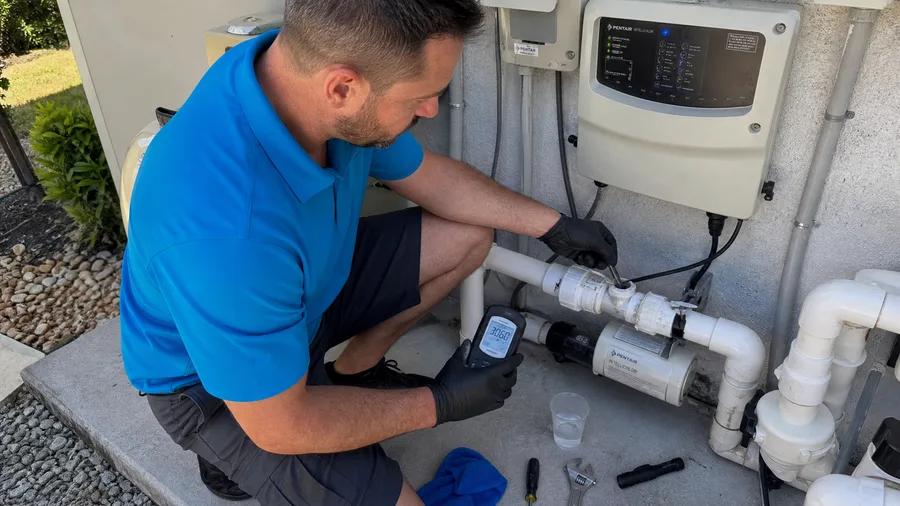
An empty feeder, restricted flow, or short operating schedule can leave free chlorine low even with appropriate CYA. Check tablet levels using the feeder's safe opening procedure. Confirm that water flows through the equipment during its scheduled operation.
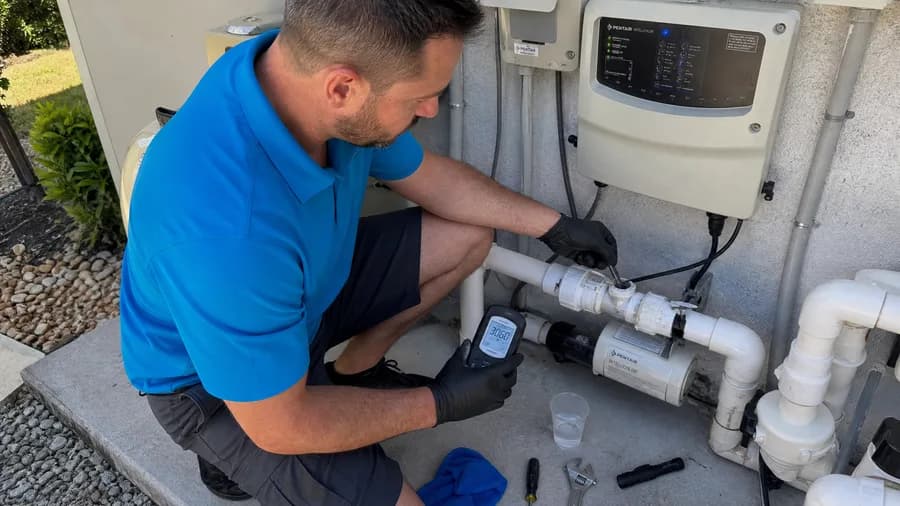
For a salt pool, check the output setting, pump schedule, and controller warnings. A powered-on controller doesn't prove the cell is producing chlorine. Check reported salt against an independent test before adding more salt. Have cell buildup or persistent flow warnings checked according to the manufacturer's instructions.
Winter adds a specific supply problem: some salt systems reduce or stop production below a set water temperature. Read your model's manual for that threshold. A cold-water warning calls for another chlorination plan while production is limited.
Our technicians confirm the equipment correction after seeing the system. A low chlorine reading alone doesn't justify replacing a salt cell. Increasing pump time also won't fix an empty feeder, inactive cell, or excessive stabilizer.
Before the next swim, verify that the correction holds
Keep swimmers out when free chlorine is zero or unconfirmed, algae is visible, or cloudiness prevents a clear view of the bottom. After treatment, follow the product's reentry requirements and verify chlorine and pH with a reliable test.
- Record the follow-up readings after the required mixing period.
- Check again before swimming and after the next normal equipment cycle to see whether chlorine holds.
- If readings remain contradictory or treatment repeatedly fails, gather chemical labels, doses, test times, and equipment warnings for a service visit.
The CDC's home pool testing guidance recommends testing chlorine and pH at least twice daily and more often during heavy use. A weekly visit doesn't replace those between-visit checks. Our weekly pool cleaning service provides ongoing cleaning and water care, with treatment adjusted to the pool's condition.