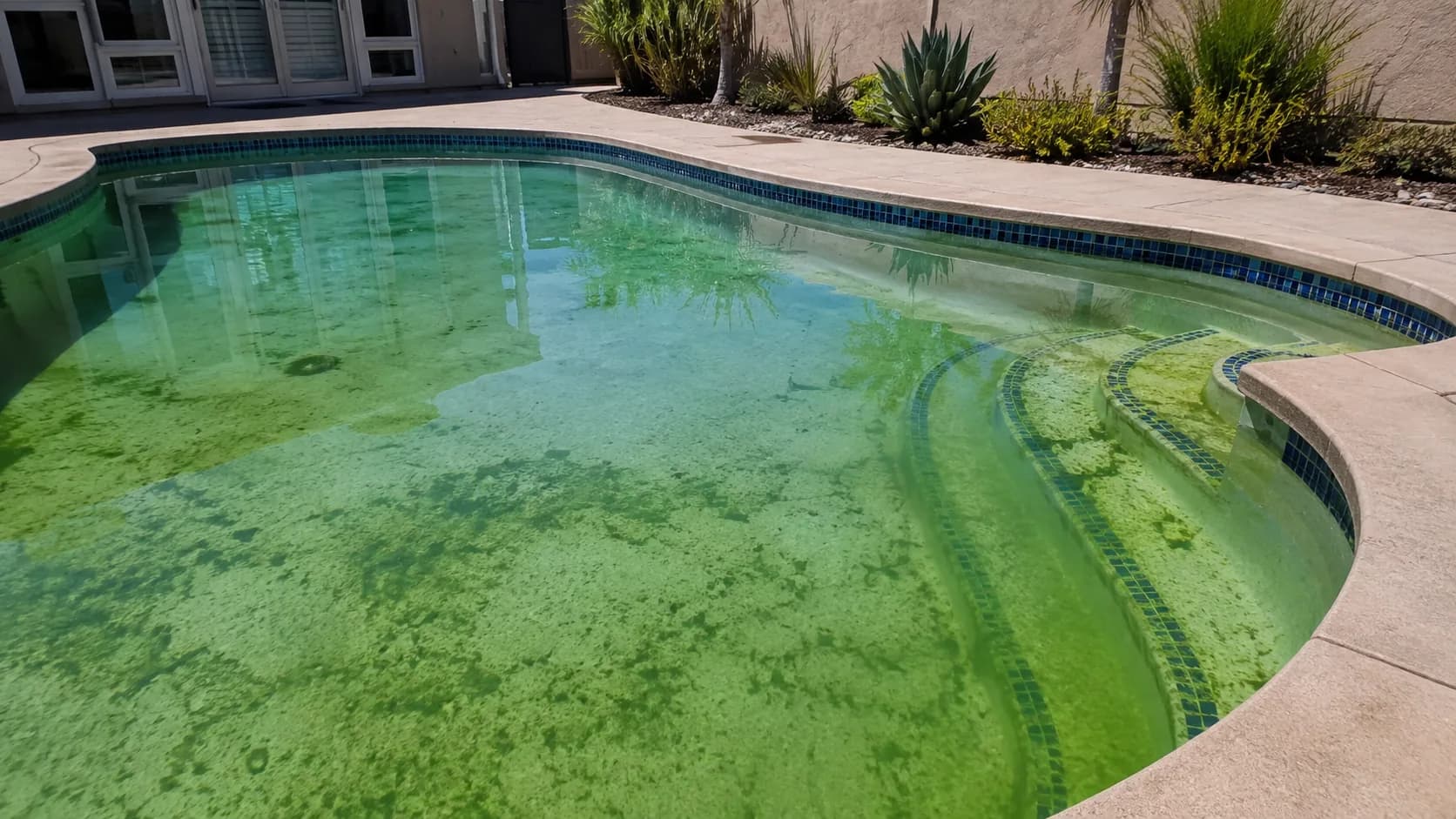
Cloudiness after shock does not always mean you need more
Your pool can turn cloudy after shocking because calcium forms white particles, dead algae remain suspended, filtration is poor, or algae treatment was too weak. If clear water turns milky immediately after shock, check the product ingredient and pH before adding another dose.
Shock treats contaminants, but your filter still has to remove the particles left behind. The change in appearance helps you choose which readings and equipment to check.
| What you noticed | Likely cause | First check |
|---|---|---|
| White haze shortly after calcium hypochlorite shock | Calcium forming visible particles | Reliable pH, calcium hardness, and alkalinity readings |
| Green water became gray or pale blue | Dead algae awaiting removal | Whether chlorine holds at the treatment level and filtration works |
| Water stayed green or surfaces remain slippery | Algae treatment is unfinished | Free chlorine, stabilizer, and the dose used |
| Haze persists with weak flow or dust at the returns | Restricted circulation or a filter problem | Baskets, filter pressure, and return flow |
Color alone cannot confirm the cause. More than one problem can occur together, such as dead algae loading an already dirty filter.
Keep everyone out if you cannot clearly see the deepest pool floor and drain cover, where present. Even when visibility returns, chlorine and pH must meet the shock label's reentry requirements.
White haze right after calcium shock: check pH and hardness
Calcium hypochlorite adds calcium as well as chlorine. Its temporary rise in pH can make dissolved calcium form visible white particles. This is precipitation: minerals coming out of solution.
Test calcium hardness, pH, and alkalinity, the water's resistance to pH changes. Consider water temperature too. A pH above 7.8 increases the chance of calcium deposits, especially when calcium and alkalinity are also high. One hardness number cannot confirm the cause.
Check free chlorine before trusting the pH result. Standard phenol red pH tests can become unreliable above the kit's chlorine limit, often around 10 parts per million, or ppm. Follow the kit's interference instructions before treating an unusual color as a reason to add acid.
If testing confirms high pH and a calcium cloud, lower pH with pool acid into the normal 7.2 to 7.8 range. Follow the acid label, calculate the dose from pool volume and readings, and retest after the required circulation period. Keep filtering while the haze clears. If pH is already in range, do not keep adding acid just because the water looks white.
This matters in San Diego, Los Angeles, and Orange County, where hard source water supplies minerals and evaporation concentrates them. Consider switching from calcium hypochlorite to liquid chlorine, which adds neither calcium nor stabilizer. Switching prevents additional calcium buildup; it does not remove calcium already present.
Sacramento and East Bay source water is generally softer. Measure the pool itself rather than assuming every white cloud comes from high calcium.
If grains remain on the floor, check the shock label's instructions for undissolved product. Brush only as directed, and predissolve only if the label permits it. Never mix chlorine products, reuse a contaminated scoop, or add acid and chlorine together. Follow each label's application and separation instructions.
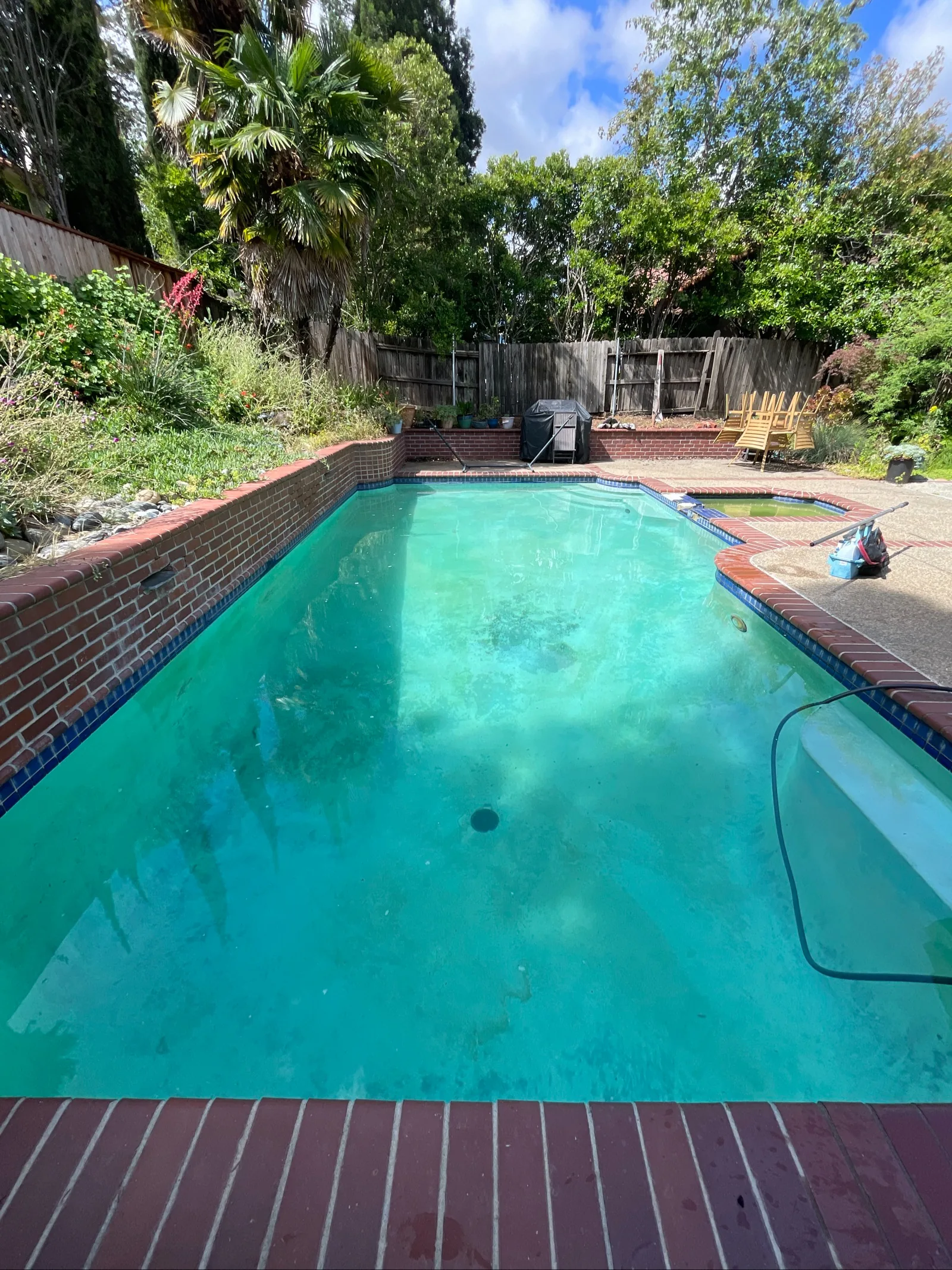
Green turned gray or blue: remove the dead algae
A green pool turning gray or pale blue suggests algae treatment is working. The remaining haze may be dead algae too fine to settle quickly. More shock alone will not remove those particles.
Keep free chlorine, the chlorine available to sanitize, at the appropriate algae-treatment level while cleanup continues. Test and replenish it according to the treatment instructions. Do not let chlorine fall back to a routine maintenance level while algae remain.
Brush the walls and floor to move debris into circulation. Vacuum settled material using a method your equipment supports. Keep the filter operating with enough flow to capture suspended particles, and monitor pressure as it collects them.
Temporary extended filtration can help, but every pump does not need to run at full speed for 24 hours. Variable-speed equipment needs sufficient flow through the filter. Longer pump hours will not fix a filter that lets debris pass through.
Fading color is encouraging, but it does not prove treatment is complete. If green patches return or chlorine keeps dropping unexpectedly, use the stabilizer and dosing checks below before treating the haze as debris alone.
Still green and cloudy: the shock dose may be too weak
Stabilizer, also called cyanuric acid, protects chlorine from sunlight but changes the chlorine level needed to kill algae. When stabilizer is high, a normal shock dose may be too weak to finish treatment. The water can stay hazy or greenish despite a recent dose.
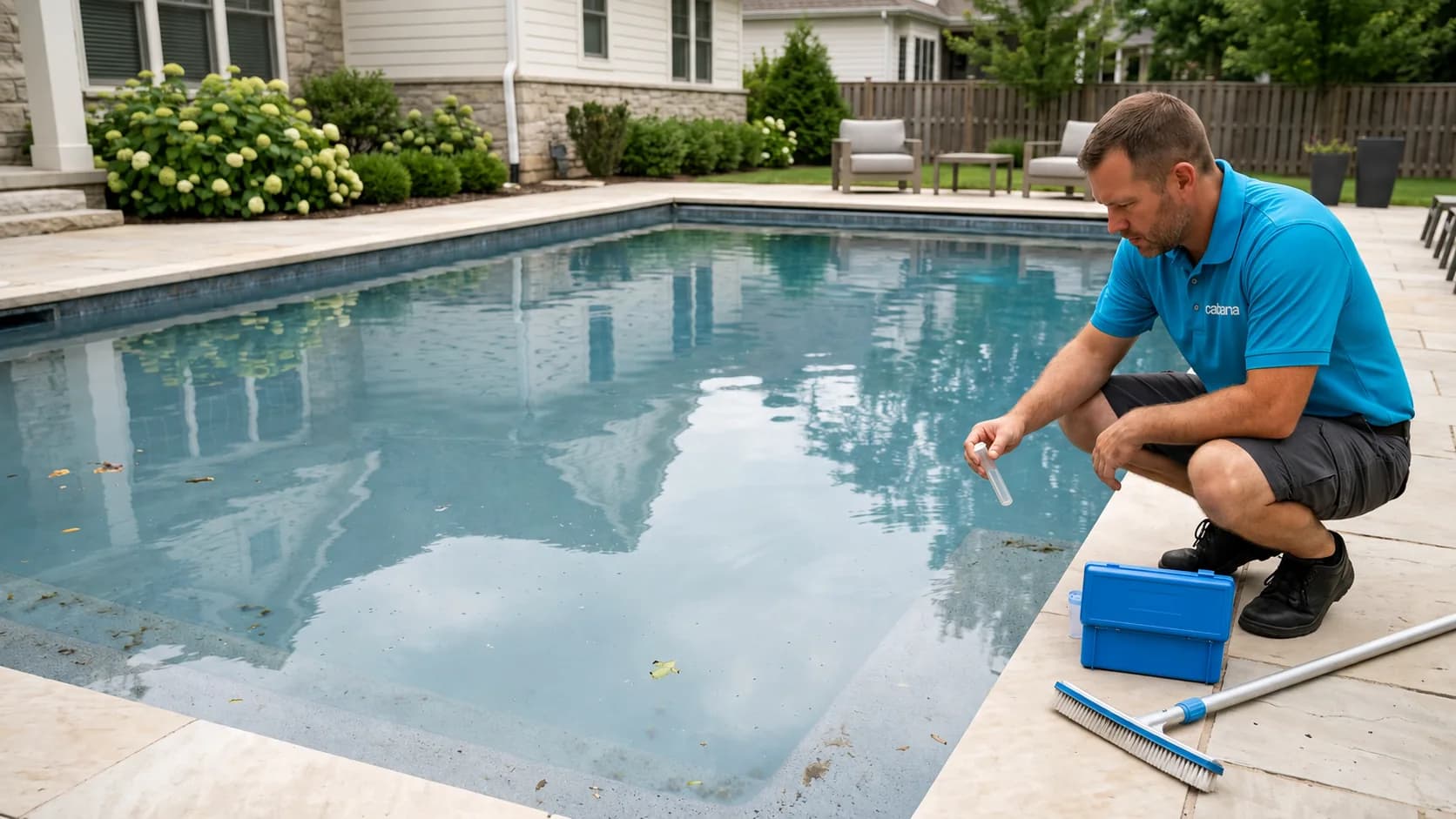
Measure free chlorine and stabilizer before choosing the next dose. Compare the shock dose with your stabilizer level using the product label or a chlorine-to-stabilizer treatment guide. A single bag is not a universal dose: pool volume, product strength, current chlorine, and stabilizer all matter.
Use a chlorine test rated for the expected treatment level. Very high chlorine can bleach some color tests and produce a falsely low or zero reading. Confirm an unexpected zero with a chlorine drop test rated for that concentration, used according to its instructions, before adding more.
If chlorine is below the required treatment level, calculate the correction and maintain that level through the algae treatment. Our guide to raising free chlorine in a pool explains the dosing checks.
Check the shock ingredient too. Dichlor adds stabilizer with every dose, so repeated applications can increase the treatment requirement. Our guide to chlorine lock and what actually fixes it explains how to address excessive stabilizer. Non-chlorine shock does not replace chlorine treatment for algae.
Haze that never clears: check the filter and water flow
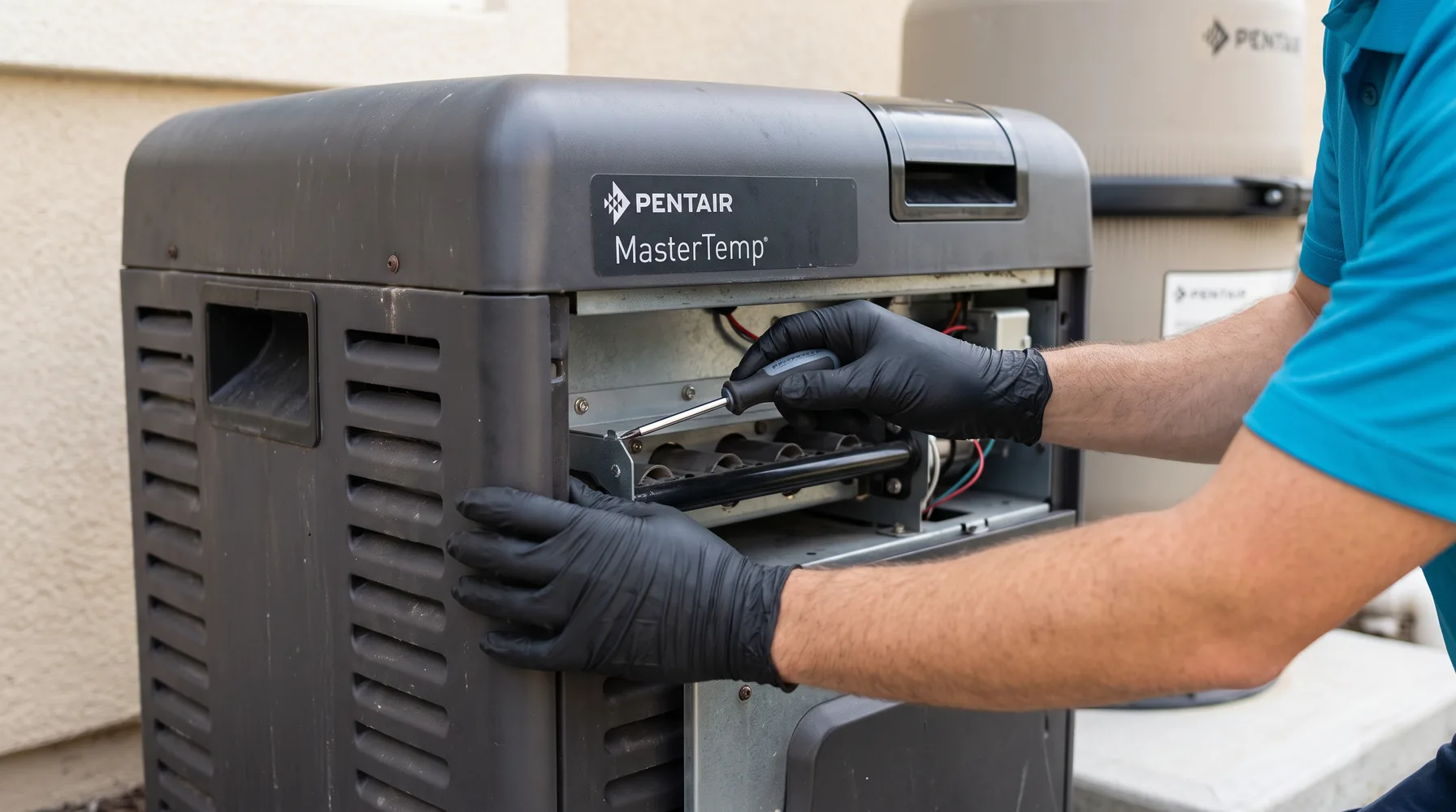
A running pump can still move too little water to clear the haze. Check the water level, accessible baskets, return flow, and filter pressure. Empty loaded baskets according to the equipment instructions.
Compare pressure with the clean-filter baseline at the same pump speed. Many filters need cleaning when pressure rises about 20% to 25%, but the manufacturer's threshold controls. For example, a clean reading of 16 psi reaches a 25% increase at 20 psi.
Clean cartridge elements when needed. Sand and diatomaceous earth filters may need backwashing, which reverses flow to flush trapped debris. Diatomaceous earth is fine filter powder; replenish the specified amount after backwashing according to the manual.
Turn the pump off and release pressure as directed before opening any filter. Never move a multiport valve while the pump is running. After cleaning or backwashing, restart the system and compare pressure with the clean baseline again at the same speed. Check whether return flow has recovered.
Weak flow with low pressure calls for checking water level, blocked baskets, air entering the system, or pump operation. Pressure that stays high after cleaning needs further inspection. Dust or filter material returning through the jets can indicate an internal filter or valve problem.
Our pool filter cleaning service can address accumulated debris. If cleaning does not restore filtration, our technicians confirm the repair after seeing the equipment.
Use the next 24 to 48 hours to check progress
Start the clearing checkpoint after correcting the cause and establishing effective filtration. Some haze improves within 24 hours; heavy algae debris can take several days. Look for visible improvement rather than assuming the water will clear within 48 hours.
- Photograph the same step or floor feature after 24 hours, from the same position in similar light.
- Record chlorine readings and filter pressure at a consistent pump speed.
- If visibility improves and readings stay on target, continue the treatment and debris-removal plan.
- If visibility stays unchanged after 24 to 48 hours of appropriate treatment and working filtration, arrange a service check.
- Get help sooner if flow drops sharply, the pump draws air, or debris comes through the returns.
Hold off on clarifier until chemistry and filtration are working. It can help a filter catch fine particles, but excess product can worsen cloudiness. Flocculant settles particles and often requires vacuuming to waste, which removes dirty water without passing it through the filter. Confirm that your equipment supports the required removal method before adding it.
When arranging a visit, save the shock label and record the amount added, application time, pool volume, and latest readings. A photo showing floor visibility also helps our technicians assess the next step. After the water clears, our weekly pool cleaning service provides ongoing chemistry and equipment checks.