Choose a surface clean, a drain, or a service visit
To clean a hot tub, remove debris, clean the waterline and filter, then test and adjust the water. Plan a drain and refill about every three to four months, sooner with heavy bathing, unless your tub manual specifies another interval.
We recommend choosing the job by water condition and equipment behavior. A few leaves do not justify a full refill. Slime returning after cleaning calls for attention to the plumbing, where wiping the shell cannot reach.
| What you find | Best next step | Time, expense, and risk |
|---|---|---|
| Loose debris or a light waterline ring, with normal circulation | Clean with the water in place | The smallest job, with no refill or reheating expense. Check chemistry before using the tub. |
| Persistent foam, oily water, excessive mineral concentration, or a scheduled water change | Clean the plumbing as directed, drain, wipe, and refill | Allow for draining, filter cleaning, refilling, and heating. Cleaner residue or trapped air can delay use. |
| Recurring slime, an unknown maintenance history, weak flow, or equipment errors | Arrange cleaning or equipment service | The work depends on contamination and equipment condition. Repeated chemical additions cannot fix a circulation fault. |
Waiting is appropriate while treatment circulates or refill water heats. It is not a reason to use cloudy water or water without an adequate sanitizer reading. For help planning the work, see our hot tub cleaning service and pricing details. Tub capacity, access, buildup, and equipment condition affect the work involved.
Move the drain date forward when use or minerals increase
Use the three to four month interval as a planning baseline, not a reason to keep deteriorating water. Several bathers using a small tub daily add oils and dissolved waste faster than occasional use. After increasing use or hosting frequent guests, check water condition and chemistry more often. Persistent foam or oily water despite correct sanitizer and a clean filter warrants an earlier change.
Mineral concentration provides another measurable trigger. Record calcium hardness after each refill, then test monthly and after periods of frequent top-offs. If hardness rises above the maximum in your tub manual, ordinary pH or alkalinity adjustments will not remove that calcium. Water replacement becomes the practical correction when lower-hardness refill water is available.
In San Diego, Los Angeles, and Orange County, hard fill water brings minerals into the tub. Evaporation leaves those minerals behind, and topping off adds more. Inland heat and dry Santa Ana winds can accelerate this cycle while the tub is uncovered. Clear water can therefore need replacement before it looks dirty.
Compare the tub's hardness reading with the current tap-water reading before draining. A refill can reset accumulated hardness toward the source-water level, but cannot make it lower than that source. If the tap water already exceeds your equipment's target, our technicians can help assess a suitable fill-water approach.
If you monitor total dissolved solids, record a startup baseline after adding the required chemicals. Use your system manufacturer's replacement threshold, especially with salt systems. Rising dissolved solids that exceed that threshold and resist normal water management also call for replacement. A single universal reading would confuse intentional salt with accumulated waste.
Clean without draining when the problem is loose dirt
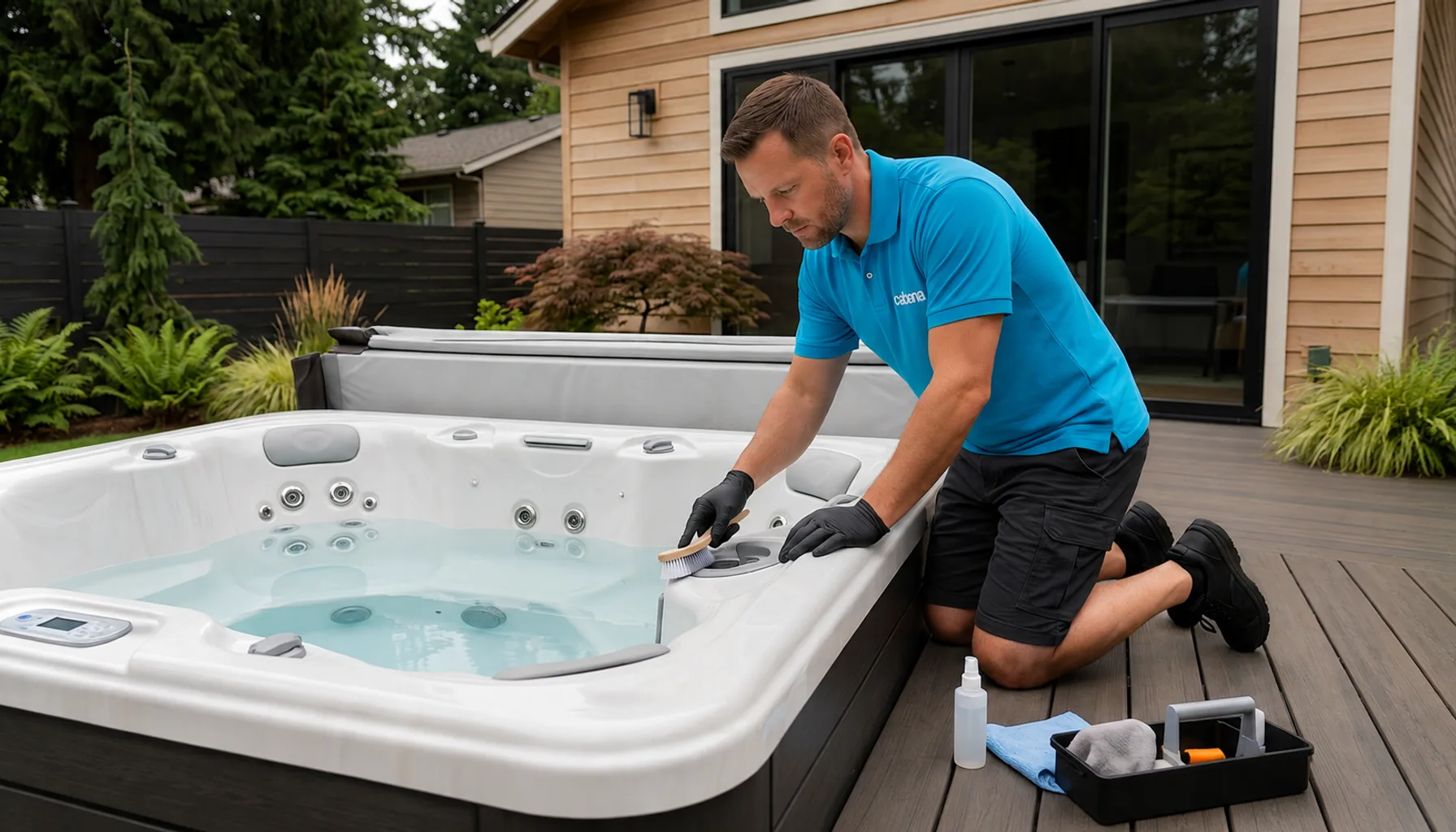
Start by removing leaves with a skimmer and settled grit with a spa vacuum. Wipe the exposed waterline with a soft cloth and a cleaner approved for your shell material. Apply it as directed, keeping concentrated cleaner out of the water.
Avoid dish soap, including Dawn. Its foaming ingredients can remain in the plumbing and create another cleanup job. Abrasive pads can scratch the shell. A nonabrasive spa cleaner is the safer default for residue that water alone will not remove.
After a Santa Ana wind event, inspect the water and filter before adding more chemicals. These winds can deposit dust, leaves, and pollen quickly. Physical debris needs removal; extra sanitizer does not remove grit.
Clean the cover separately. Brush off loose debris, then wipe its underside and clean the exterior according to its care instructions. Rinse away cleaning residue before replacing it. If a heavy, waterlogged cover is difficult to lift, arrange help rather than dragging it across the shell.
Clean the filter before blaming the water
A dirty cartridge restricts flow and holds oils that can contribute to cloudy water. Turn off power before removing it, and follow the tub's instructions for releasing its housing. Do not run the tub without the filter unless its cleaning procedure specifically requires that step.
- Remove the cartridge and inspect its pleats, end caps, and center core.
- Rinse between the pleats with a garden hose. Avoid a pressure washer, which can damage the filter material.
- If the pleats remain greasy, use a compatible cartridge cleaner for the stated soaking time.
- Rinse thoroughly before reinstalling. Residual cleaner can cause foam.
Replace a cartridge with torn pleats, a broken core, or damaged end caps. Cleaning cannot restore those parts. Follow the filter manufacturer's replacement guidance even if the cartridge still looks intact.
If circulation remains weak after cleaning and correct reinstallation, stop repeating the rinse. Check the water level and displayed errors. Our technicians can confirm whether the restriction comes from the filter, trapped air, or equipment after inspecting the system.
Purge, drain, and wipe in the right order
A full clean must address both the shell and the water passages. A plumbing purge loosens deposits inside the lines, but it does not replace sanitizing the water. For a tub with recurring slime or a long period of disuse, arrange a cleaning and disinfection plan before bathing.
- Check the instructions before starting. Confirm the tub's draining procedure, shell material, and compatibility with the selected plumbing cleaner. Identify a suitable wastewater destination before opening the drain.
- Purge while the tub still contains water. Use a spa plumbing cleaner at its labeled dose and circulation time. Follow its instructions for filters and accessories. Do not combine cleaners or improvise chemical mixtures.
- Disconnect power before draining. After the purge cycle, switch off power at the breaker. The heater and circulation pump must not operate as the water level drops.
- Drain using the approved method. Use the tub's drain or an appropriate submersible pump as directed. Remove remaining puddles so loosened residue does not stay behind.
- Wipe the shell while residue is damp. Use a soft cloth and approved nonabrasive cleaner. Clean around jet faces and headrests, removing components only where the manual permits.
- Rinse and remove the rinse water. Pay attention to seats, footwells, and recesses. Cleaner left behind can make fresh water foam.
Do not assume household vinegar is suitable for every surface, seal, or metal fitting. Use it only where the equipment manufacturer permits it, and never mix it with chlorine products. For stubborn mineral deposits, select a compatible spa scale cleaner rather than scrubbing harder.
Refill according to your source water
Reinstall the clean filter and close the drain before filling. Keep power off until water reaches the specified operating level. Fill through the location identified in the manual, often the filter compartment, to reduce trapped air. Restore power and confirm circulation before enabling heat.
Test fresh water for pH, total alkalinity, and calcium hardness. With Southern California's harder source water, do not automatically add calcium increaser from a startup kit. Compare the measured hardness with your equipment's target first.
Sacramento and East Bay source water is generally softer. Those tubs may need calcium adjustment even when a Southern California tub does not. Use the measured result and your tub's specified range rather than repeating a chemical dose used elsewhere.
Adjust water balance using the tub manufacturer's startup instructions and product labels. If alkalinity needs correction, our guide to lowering hot tub alkalinity explains that separate task.
Add the appropriate sanitizer, circulate for the required time, and retest. For chlorine tubs, maintain at least 3 ppm free chlorine within the product's permitted operating range. For bromine tubs, maintain 4 to 8 ppm. Keep pH between 7.2 and 7.8 unless your equipment instructions specify a narrower range. Never mix chlorine and bromine products together.
Use these checks before getting back in
A refill is ready for use when circulation works, the water is clear, and measured chemistry meets operating targets. Water temperature alone does not establish readiness. Reheating time varies with fill temperature, tub volume, and heater output, so avoid assuming a same-evening soak.
- Confirm flow: Check for normal circulation and unresolved flow or heater errors.
- Check water clarity: You should be able to see the bottom clearly.
- Measure chemistry: Verify sanitizer and pH after the required circulation period. Follow any longer waiting period on the chemical label.
- Inspect for residue: Persistent foam after rinsing may point to leftover cleaner or contamination in the lines.
- Start a refill record: Write down the date, startup hardness, and your next planned water change. Keep test results together so a rising mineral concentration is easy to spot.
If an error returns, circulation stays weak, or slime quickly reappears, stop using the tub and request a hot tub cleaning or equipment inspection. Tell our team what you found, which products you used, and whether the problem started before or after draining. Those details help us plan the next service step.