Start a treatment log with alkalinity and pH together
To lower alkalinity in your pool, use pool acid: roughly 25 to 26 fluid ounces of 31.45 percent muriatic acid per 10,000 gallons lowers total alkalinity about 10 ppm. Add only a partial dose first, and use your pH reading to prevent treatment from pushing pH below 7.2.
Start a log with the date, total alkalinity, pH, and any recent chemical additions or top-ups. Total alkalinity measures resistance to pH changes. It is different from pH, and acid lowers both. Use 80 to 120 ppm as a starting alkalinity reference, then check the operating guidance for your sanitizer system.
Across over 5,800 readings on our Sacramento-area routes, median alkalinity is 70 ppm and the middle 80 percent runs from 60 to 110 ppm. A sudden result of 160 ppm deserves a repeat test before acid, especially if previous entries were much lower. Across over 16,000 Los Angeles readings, the middle 80 percent runs from 80 to 130 ppm. A reading of 130 ppm with stable pH calls for checking the full balance before starting a large correction.
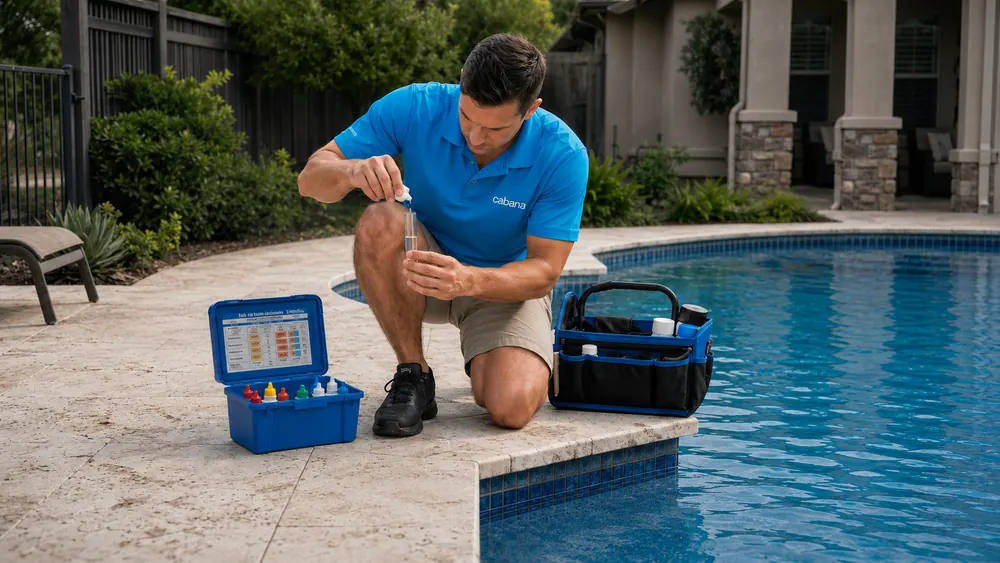
Use a drop-based test kit and sample away from return jets or recent chemical additions. Follow the kit's endpoint instructions. After shocking, check its chlorine interference guidance before trusting pH or alkalinity results. Record calcium hardness, cyanuric acid, and water temperature alongside the first confirmed reading.
Match the confirmed readings to the next action
| Confirmed readings | Next action |
|---|---|
| TA above the system's target, pH above 7.8 | Calculate a staged acid correction. Both readings need attention, but pH limits each addition. |
| TA above target, pH between 7.2 and 7.8 | Check pH drift and calcium balance. If correction is needed, use smaller acid steps with aeration between them as necessary. |
| TA above target, pH at or below 7.2 | Pause acid. Raise pH through aeration before reconsidering an alkalinity dose. |
| TA within target, pH above 7.8 | Calculate a pH correction instead of dosing for a large alkalinity reduction. |
| TA and pH within their operating ranges | Leave them alone and compare the next routine readings. |
High alkalinity can contribute to persistent upward pH drift. Alongside high pH and calcium hardness, it increases the risk of calcium carbonate cloudiness and scale. Cloudiness alone does not identify alkalinity as the cause. If chemistry is balanced, follow our cloudy pool troubleshooting guide to check other causes.
In San Diego, Los Angeles, and Orange County, hard, mineral-heavy source water makes calcium hardness especially relevant before treatment. Acid does not remove calcium. Sacramento and East Bay source water is generally softer, so check for low calcium before pursuing a lower alkalinity target.
For a scale or corrosivity assessment, use a saturation balance calculation that includes temperature and accounts for cyanuric acid's contribution to measured alkalinity. A single TA number cannot replace that check.
Check what happened before alkalinity rose
Before treating a recurring problem, compare the latest reading with the last chemical addition or substantial top-up. This gives the next correction a purpose and helps prevent immediately undoing it.
| Log pattern | What to check |
|---|---|
| TA rises after adding a balancing product | Check for sodium bicarbonate or sodium carbonate in the ingredients. |
| TA rises after substantial top-ups | Test alkalinity in the actual hose water and compare it with the pool. |
| pH rises while TA stays steady | Check fountain, spillover, and return operation for unnecessary aeration. |
| One reading changes sharply without an obvious event | Repeat the test before calculating treatment. |
Baking soda raises alkalinity; it does not lower it. Sodium carbonate, commonly sold as pH increaser, also raises alkalinity. If the log points to an excessive baking soda addition, stop adding it while calculating the correction. Our baking soda dosing guide explains its proper use when alkalinity is low.
Shocking generally does not lower alkalinity. Calcium hypochlorite and liquid chlorine can initially push pH upward. Use shock for a sanitizer need, not as an alkalinity treatment.
Hot inland valleys and dry Santa Ana winds can increase Southern California top-up demand compared with milder coastal pools. Sacramento's long, dry summers also increase replacement demand. Test fill-water alkalinity after a recurring rise rather than assuming softer water means lower alkalinity.
Water replacement lowers TA only if the replacement water has lower TA. If calcium is also accumulating, our technicians assess whether pool water replacement and restart service would help before recommending it.
Calculate the correction, then reduce the first dose
Use confirmed pool volume, product strength, and the desired TA reduction. These approximate quantities each lower alkalinity by 10 ppm in 10,000 gallons:
| Acid product | Approximate quantity |
|---|---|
| Muriatic acid, 31.45 percent hydrochloric acid | 25 to 26 fluid ounces |
| Dry acid, approximately 93 percent sodium bisulfate | 34 ounces by weight, about 2.1 pounds |
Multiply the reference quantity by pool gallons divided by 10,000, then by the desired ppm reduction divided by 10. Different concentrations require different quantities. Follow the product label, and check equipment guidance before choosing dry acid because it adds sulfate.
Worked example: A 15,000-gallon pool reads 140 ppm TA, and its selected target is 100 ppm. Using 26 fluid ounces as the reference, the estimated total correction is 26 × 1.5 × 4 = 156 fluid ounces of 31.45 percent muriatic acid. The approximate dry-acid equivalent is 34 × 1.5 × 4 = 204 ounces by weight.
That total is a treatment estimate, not a single pour. Start with no more than half the calculated correction, and less if pH requires it. In this example, 78 fluid ounces is the half-dose ceiling. Use a dosing calculation that includes current pH and alkalinity to check whether even that amount would lower pH too far. If so, use the smaller pH-limited amount. At pH 7.2, add no further acid.
Record the actual amount added. Uncertain pool volume or an unreadable product concentration is a reason to resolve the measurement before dosing.
Make each log entry a dose, a retest, and a decision
- Add the selected partial dose safely. Keep swimmers out, use the label's protective equipment, and circulate as directed. Never mix acid with chlorine or other chemicals, or add acid through a skimmer.
- Follow the label's application method. Avoid a concentrated acid slug or an acid pocket created by stopping circulation. If dilution is required, add acid to water, never water to acid.
- Allow thorough mixing. Follow the product's circulation and testing instructions. Sample away from the addition point, then record pH and TA beside the dose.
- Choose the next step from the new readings. Continue only if TA remains above target and pH permits another small addition. Recalculate from the measured result rather than automatically adding the unused half.
If pH reaches about 7.2 before TA reaches its target, pause acid and aerate with an existing fountain, spillover, or return adjustment. Aeration releases carbon dioxide, raising pH without materially raising alkalinity. It cannot lower TA by itself.
You can adjust alkalinity and pH during the same treatment, but cannot lower TA with acid without also lowering pH. Alternating small acid additions with aeration manages that tradeoff. Retest rather than assuming aeration will take a fixed number of hours.
Use existing circulation time where practical while meeting the label's mixing requirements. California electricity rates make unnecessary extra pump operation worth avoiding. Stop extra aeration once pH returns to the chosen operating range.
Use the following day's readings to close the treatment
When TA reaches the selected target and pH is within 7.2 to 7.8, stop acid additions. Do not keep dosing to match an exact round number. If TA is on target but pH remains low, use aeration without adding an alkalinity increaser.
Check again the following day under normal circulation. Before swimming, satisfy the chemical label's waiting requirements and confirm appropriate pH and sanitizer levels. If pH falls below 7.2, keep swimmers out while correcting the balance.
Keep the completed log through the next substantial top-up. Record its approximate volume and the next TA reading. If the problem returns, that comparison helps distinguish an incoming-water issue from chemical additions or pH drift.
For readings that remain inconsistent or corrections that repeatedly fail, our weekly pool cleaning and water chemistry service can track the pattern alongside equipment operation. Our technicians confirm the appropriate correction after checking the water and seeing the equipment.